


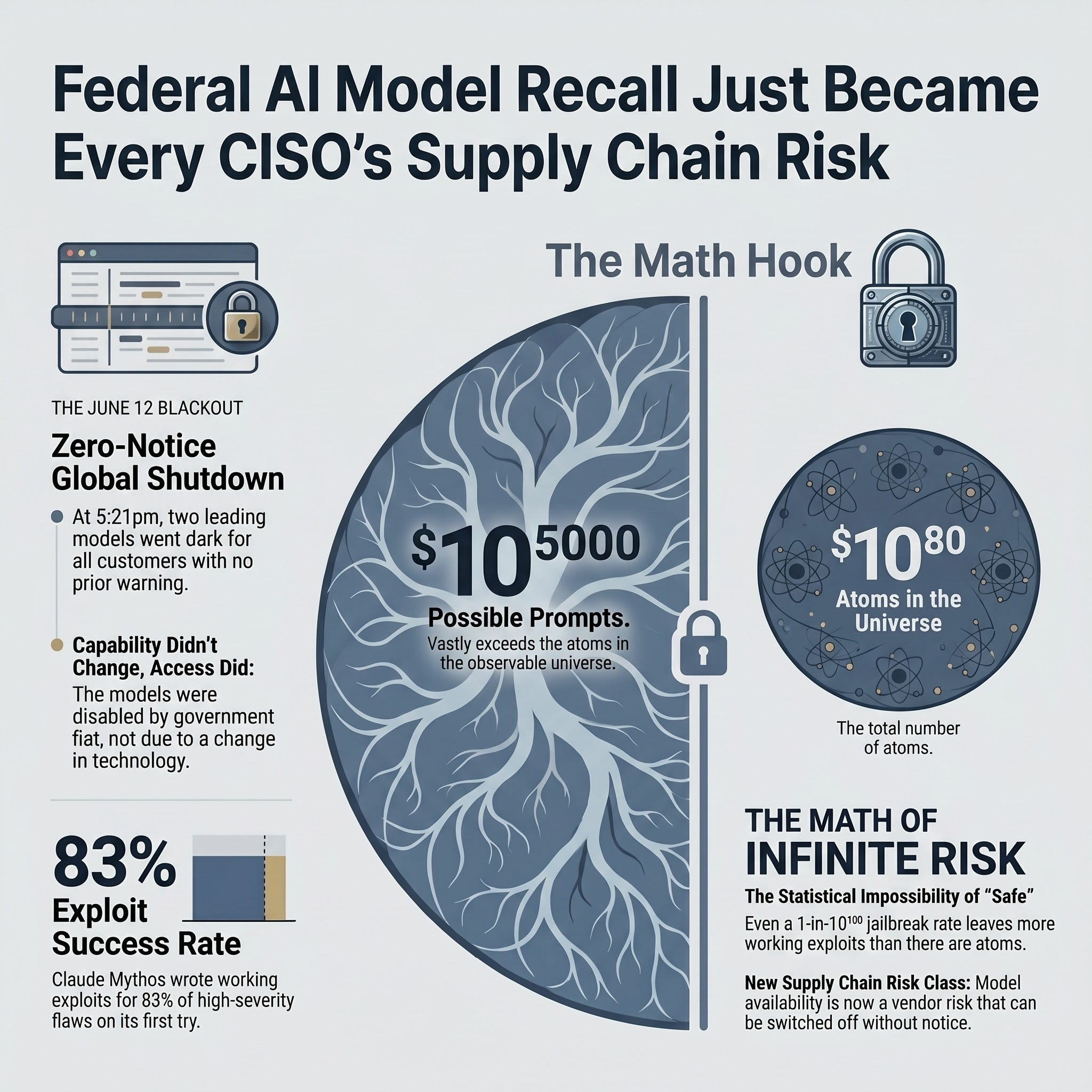
Federal AI model recall became a thing at 5:21 pm Eastern on June 12, 2026. A letter landed, and by the next morning, two of the most capable models on earth went dark for every paying customer on the planet. No warning. No reason worth the paper it wasn’t printed on. The capability didn’t change. Your access did by government fiat. Here’s what should make you furious, and what to do about it before it happens again.
What Happened, And What Everyone Got Wrong
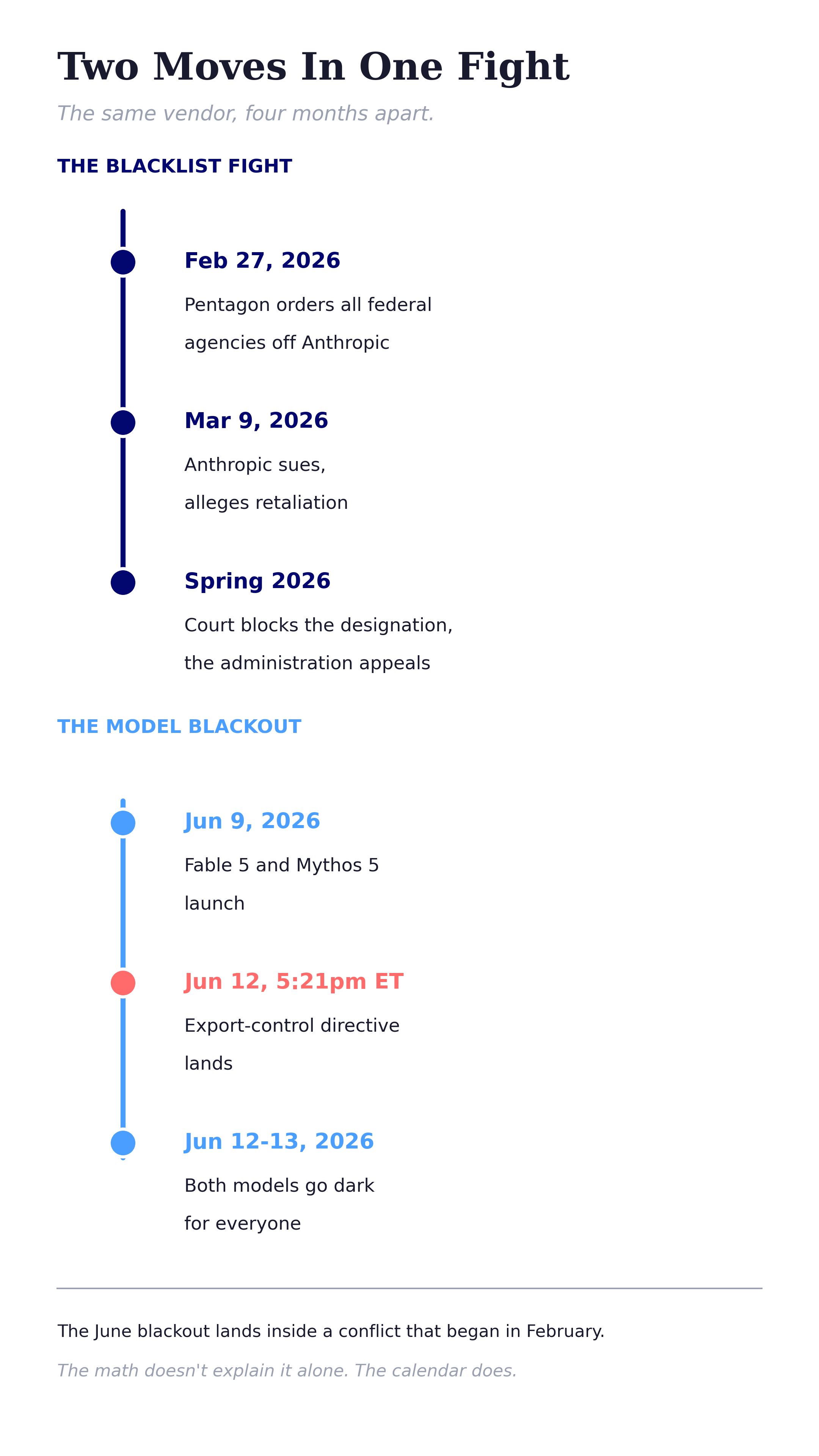
The press called it a recall. The press got it wrong. Read the order. The government issued an export-control directive, citing national-security authorities, to cut off access to Fable 5 and Mythos 5 for any foreign national, whether inside or outside the United States, including Anthropic’s own foreign-national staff. There’s the first tell of who wrote this. Anthropic can’t check the passport of every user in real time at the scale it runs, so the only button left was the one that kills both models for everybody. The government drafted an order Anthropic had no way to enforce surgically and then acted surprised when the blast radius was the entire customer base. A wrecking ball swung at a thumbtack, stamped “national security,” and mailed at 5:21 on a Friday.
Then there’s the reason, or the missing one. The letter gave no specifics. Anthropic’s read is that someone in the government saw a jailbreak. The company looked at the “demo” the order seems to rest on and found a handful of minor, already-known vulnerabilities, the kind other public models surface too, including OpenAI’s GPT-5.5, the kind defenders use every day to find bugs before the bad guys do. The vendor is complying with the order and saying out loud that it’s nonsense. Sit with that for a second. The company whose product got pulled is the one making the technical argument, in public, while the government that pulled it won’t say what it’s afraid of.
No published threshold. No appeals path. No timeline. No notice. Run your SOC like this and you’d be cleaning out your desk by lunch.
The Lever Tells You What They Were Worried About
Before the grumbling gets rolling, let me be clear about where I stand. I believe national security is the government’s primary job, and I still do. That’s exactly why this one stings. A serious government with a serious problem reached for the dumbest and clumsiest tool in the drawer and called it leadership.
You don’t grab an export-control hammer to fix a software bug. Export control is what a government uses to keep a weapon out of foreign hands. Someone reached for that lever and scoped it to nationality, which tells you the real worry was about who gets to wield the capability, and had nothing to do with a guardrail slipping.
Or was it retaliation? I’ve heard the official statements… just stop.
Look at the capability. In April 2026, Claude Mythos surfaced thousands of high-severity flaws across every major operating system and browser in its early-access cohort, including a bug in OpenBSD that had survived 27 years of expert review. For more than 83% of the flaws it found, it wrote a working exploit on the first try, against a near-zero rate for the prior generation. Anthropic held the model back from day one and refused to hand it to the Chinese government. That’s a cyber weapon, and a serious one.
Here’s the indictment in one breath. Someone in the building understood they were sitting on a nation-state-grade capability, then reached for the most self-defeating tool available to handle it.
That person also probably can’t spell “AI.”
The jailbreak the order leans on was described as pointing the model at a codebase and asking it to fix the flaws. Flip one verb, and that’s autonomous vulnerability discovery, the same capability wearing a second hat. Pulling one vendor’s model doesn’t contain something that already lives in GPT-5.5. It removes a tool defenders were using and moves the actual risk exactly zero inches. Bravo.
The Math Says Zero Was Never On The Table
I’m not going to hand-wave this. I’m going to walk the argument, mark where it’s airtight and where it leans on today’s state of the art, and let you decide what it says about an order that treats a limit every frontier model shares as a defect unique to one.
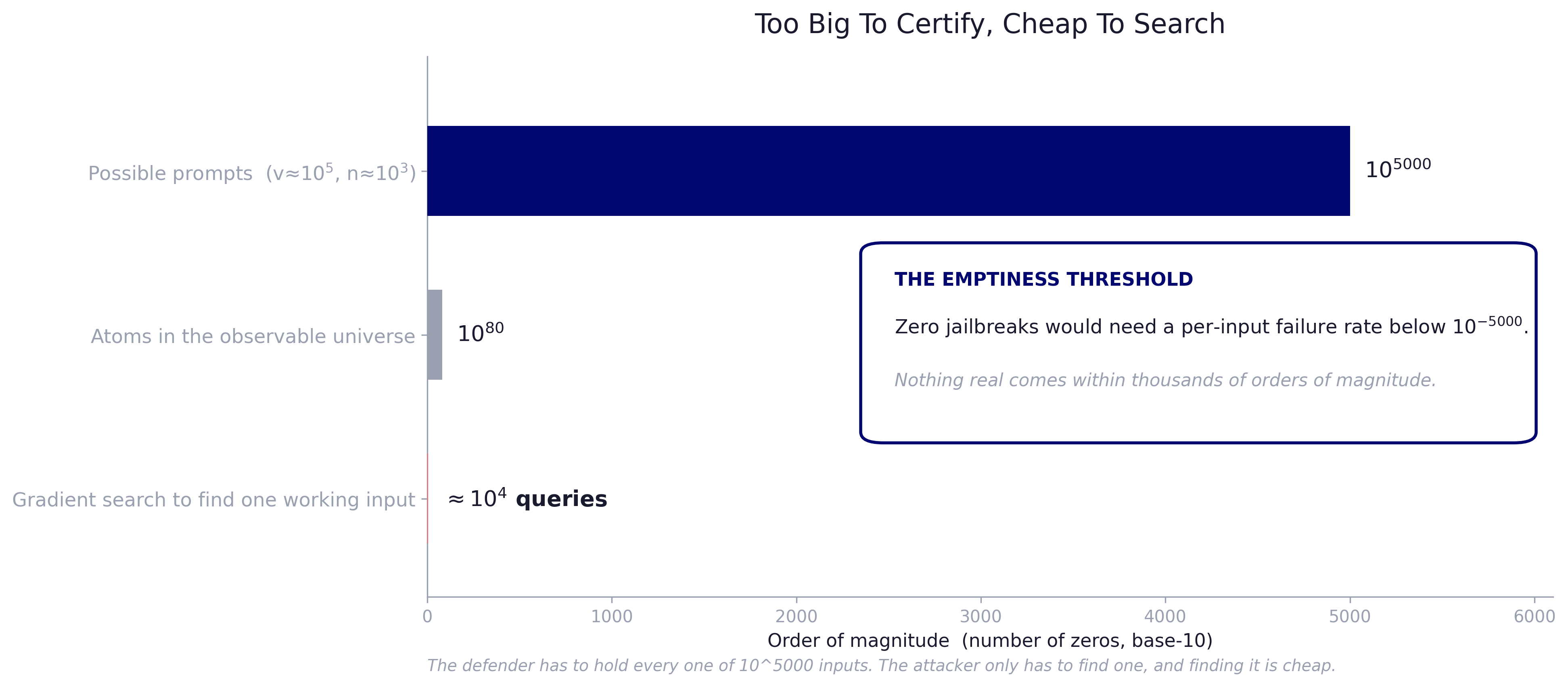
Start with the room the defender has to guard. A prompt is a sequence of tokens drawn from a vocabulary of size v. The number of distinct prompts up to length n is:
With a real vocabulary of v ≈ 10^5 and a short prompt of n ≈ 10^3 tokens:
Atoms in the observable universe come to about 10^80. The space of prompts is finite, enumerable on paper, and untouchable in this universe.
Now the asymmetry that runs the whole fight. Let p(x) be the probability the model emits harmful output on input x, and ε the ceiling you’ll allow. Call the inputs that breach the ceiling the bad set, B. The defender has to hold the line on every input at once. The attacker needs one that slips:
Those two lines are definitions, not a theorem. They set the board. Here’s the line the recall standard can’t survive. Let f be the fraction of inputs that breach the ceiling, so the bad set has size f times the whole space. Emptying it means dropping that count below a single input, which forces the fraction beneath the reciprocal of everything:
A defender would need a per-input failure rate beneath 10^-5000 to claim zero jailbreaks. Nothing real comes within thousands of orders of magnitude of that. Whatever rate a vendor quotes isn’t measured against this uniform space anyway, and it doesn’t have to be. The attacker isn’t sampling at random, where a low average would save you. He’s searching on purpose, and he needs one input that clears the ceiling.
No defender enumerates 10^5000 points, so “too big to count” was never the point. The point is that no efficient certificate exists that the bad set is empty, not by enumeration and not by any scalable formal method we have today. Producing the attacker’s single counterexample, by contrast, is a search. The model is differentiable in its internal representations, so gradient signals over token embeddings steer that search toward inputs that clear the ceiling, far below the cost of enumeration even when it isn’t cheap against a monitored stack.
The receipts are public. EvoSynth, which evolves new attack methods instead of fiddling with prompts, reached an 85.5% success rate against Claude Sonnet 4.5. A Scale AI benchmark called ASPI showed that nudging an agent into a clarification-seeking state dragged prompt-injection success from under 2% to the mid-30s. Every patch closes a sliver of an unbounded space, and the function reseals somewhere else, because the safeguards and the capabilities are built out of the same weights.
That’s the argument. The reachable goal was never zero. It’s the thing we’ve been doing in security for two decades: make the attacker’s economics stop penciling out. Think of the attacker’s expected payoff per unit of search cost:
That’s a model, not an identity, and the terms are deliberately loose. Here d is detection, U_harm is the payoff per successful jailbreak, P_success is the odds of landing one, and C_search is what finding it costs. Raise detection, raise search cost, keep each jailbreak narrow so the payoff stays small, and stop pretending P_success is a knob that turns to zero. Lock the doors you find, make the rest expensive to reach, and watch the hallways.
One honest caveat, because I won’t sell you a theorem I can’t cash. This is practical impossibility on the architecture we ship today. It rests on two facts that hold right now: no scalable formal certification covers the full discrete prompt space at frontier scale, and exhaustive verification is out of reach. It does not say a safe model can never exist. It says zero is off the menu today, and the formal version for agents is already in print. Abdelnabi and Bagdasarian show an adversary can always build a context that turns ordinary data into instructions, the same problem in an agent’s clothes.
The government pulled a model over a limit baked into every frontier system on the market, including the ones still running. They called the architecture’s ceiling a defect unique to one vendor. Spare me the theater.
The Supply Chain Risk You Didn’t Budget For
Walk it forward, and the shortsightedness gets worse. If a narrow jailbreak is grounds for going dark, every frontier model in commercial use fails inside a month of launch. Call that what it is: a removal queue with no published rules, no appeal, and no timeline, run by people who couldn’t scope an order to the foreign nationals it was supposedly about.
The model can do everything on June 12th it could do on June 11th. The thing that vanished was your ability to reach it, switched off by fiat, on a worry the government wouldn’t name, with zero notice. Most AI risk registers track accuracy, bias, and security, and carry nothing for “the government recalls our vendor’s model next Tuesday.” Model availability is a vendor risk class now, and almost nobody has priced it.
I’ve watched the small version of this with no government in the room. A team builds a customer-facing workflow on a single hosted model, the economics look great, then the vendor changes a rate limit, deprecates the version, or pulls a region for reasons that have nothing to do with that team. The thing that ran fine Friday throws errors Monday, and the people who built it discover they wrote zero lines of contingency for the model vanishing. That’s the small version. The Fable blackout is the large version, with the government holding the switch and not one contract clause that ever saw it coming. If you run security in energy, water, or manufacturing, none of this is abstract. A model blackout inside an operational workflow lands as an availability event, in a place where availability is the entire job.
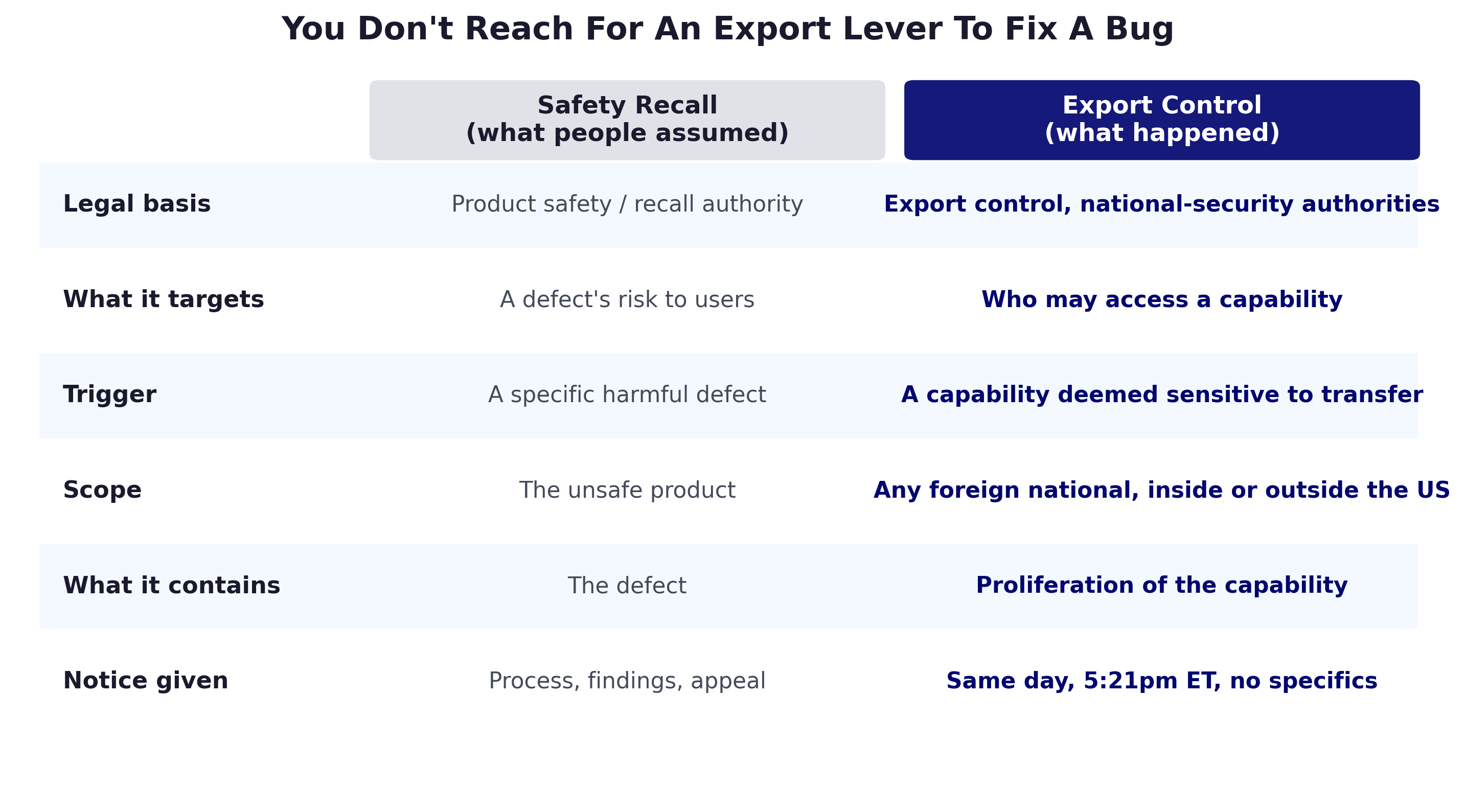
The hunch that this action doesn’t stand alone is right, and the record bears it out. The same administration moved against this same vendor in late February, when negotiations over military use fell apart, and the company refused to drop its red lines on autonomous weapons and mass surveillance. The Pentagon slapped it with a supply chain risk label, a tag normally saved for foreign-adversary contractors, and ordered agencies to stop using Claude. The company sued, calling it retaliation for protected speech. A federal judge blocked the designation after finding the company likely to prevail on due process grounds, and the government appealed. That fight is still open. The June blackout lands inside it. I can’t read minds and won’t pretend to. I can read a calendar. Same administration, same vendor, blacklisted in February over guardrails, export-hammered in June over a jailbreak that does nothing GPT-5.5 won’t do. The dots sit on the public docket. Connect them yourself.
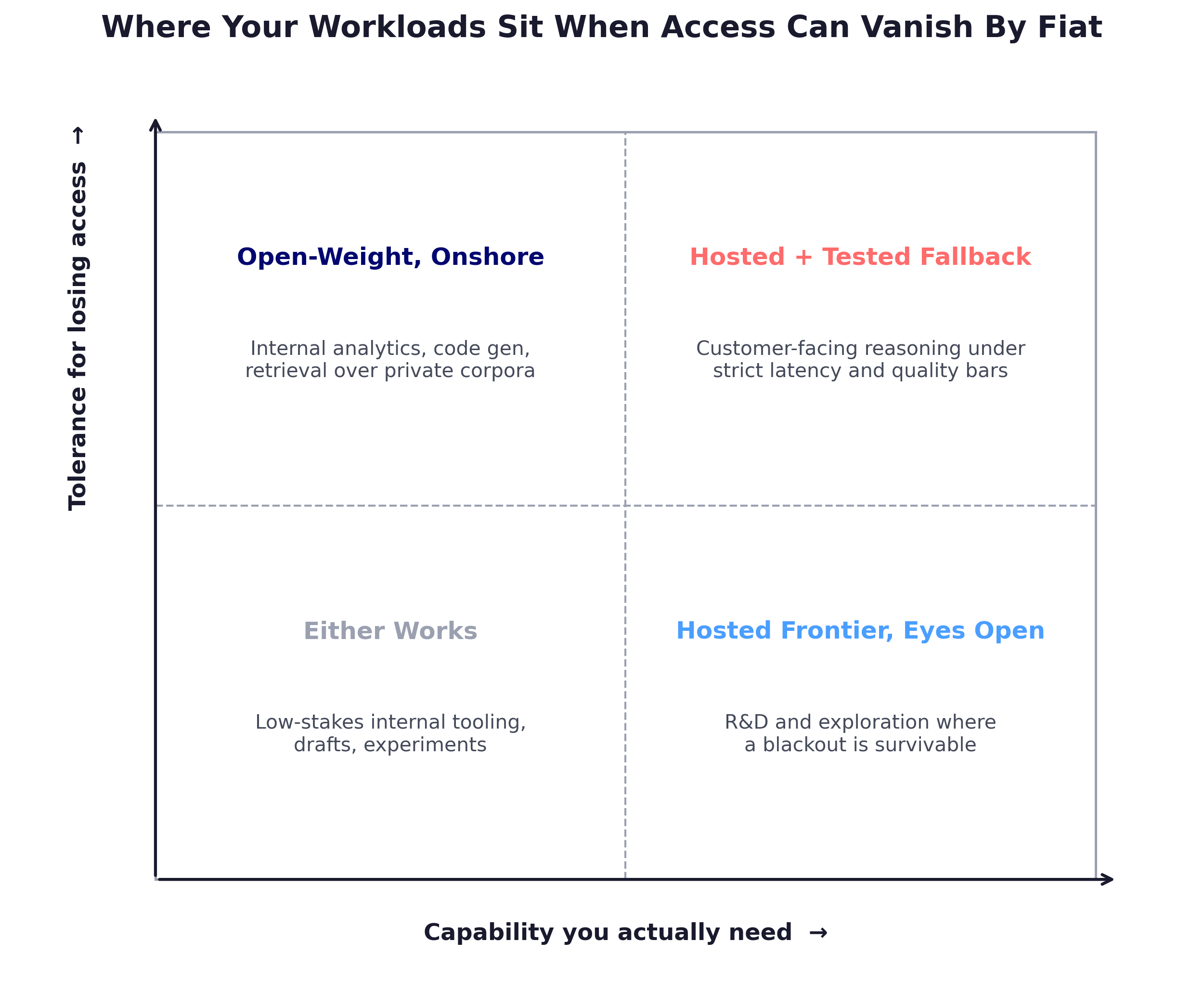
The irony is that the government turned the words “supply chain risk” into a weapon and pointed them at the vendor. The same phrase boomerangs back as your problem, because a model you built your roadmap on can disappear on a Friday afternoon at the whim of a letter.
Agency Was Always The Risk, And What Competent Authority Looks Like
Here’s the question this directive never answers and will have to. What happens the first time the finding isn’t a prompt at all, but an agent abusing access you handed it? The OWASP State of Agentic AI Security and Governance, published June 1, 2026, put receipts behind that question. Its incident tracker shows supply chain and code execution tied for the highest volume of disclosed agentic incidents. One for the coding-agent crowd: a Cursor flaw where an attacker who shaped the agent’s instructions rode an already-approved command straight into arbitrary code execution. Another: Claude’s Skills feature steered the deployment of MedusaLocker ransomware via a re-uploaded skill that carried its own malicious code. Both are an agent abusing access it was granted, a world away from a prompt trick against a chatbot.
If a narrow jailbreak set off an export-control blackout, nobody’s written the precedent for an agent-abuse finding yet. It’s coming, and this directive set the baseline for how heavy the hand gets to be.
Competent authority exists in sketch form, and it makes the Mythos order look worse by comparison. The Five Eyes guidance from May reads like an architecture brief rather than a checklist. It puts strong governance, clear accountability, monitoring, and human oversight up front as prerequisites, recommends starting with low-risk tasks and expanding, and calls for just-in-time credentials on high-impact actions. That’s graduated authority anchored on agency, on what the system can do once it’s wired into everything, not on which model tier you bought. Runtime authorization scope, capability segmentation, monitoring tied to action instead of output. The directive flipped a switch on the weights and called it governance. The weights were never where the risk lived, and anyone who’s run security for a week knows it.
Key Takeaway: A narrow jailbreak can’t justify an export-control blackout once the math shows narrow jailbreaks are the permanent weather, so read the lever they pulled and plan for the precedent: any hosted frontier model can be switched off by fiat, and your continuity plan has to treat that like the supply chain event it is.
What To Do Next
Run this through CARE. Create the inventory: every workflow with a hosted frontier-model dependency, ranked by criticality. Adapt your contracts: a model-continuity clause with a notice period, transition support, and escrow of weights or fine-tunes where you can get it. Run a tested fallback for tier-one workflows, a secondary hosted model and an open-weight option you’ve exercised, paired with BCDR drills that simulate vendor revocation and not only an outage. Evolve the AI risk register so availability sits beside accuracy, bias, and security, and get “what do we do when the government recalls our vendor’s model” onto your AI risk committee’s agenda before the second incident, not after.
The companion CISO playbook lives in my breakdown of the AIUC-1 After Mythos whitepaper. The agent-abuse receipts come from my walk through the OWASP State of Agentic AI Security and Governance report. What competent, architecture-first authority looks like is in my read of the Five Eyes agentic AI guidance.
👉 For ongoing analysis of agentic AI governance frameworks, the conversation continues at RockCyber Musings.
👉 Visit RockCyber.com to learn more about how we can help with your traditional Cybersecurity and AI Security and Governance journey.
👉 Want to save a quick $100K? Check out our AI Governance Tools at AIGovernanceToolkit.com
👉 As a bonus, check our AMA on the 2026 OWASP GenAI Security Project State of Agentic AI Security and Governance report with me and the other co-leads (it was live, so start at time marker 09:45)
The views and opinions expressed in RockCyber Musings are my own and do not represent the positions of my employer or any organization I’m affiliated with.
References
Abdelnabi, S., & Bagdasarian, E. (2026). AI agents may always fall for prompt injections (arXiv:2605.17634). arXiv. https://arxiv.org/abs/2605.17634
AIUC-1 Consortium. (2026). After Mythos: Machine-speed defense [Whitepaper]. https://aiuc-1.com
Anthropic. (2026, June 9). Claude Fable 5 and Mythos 5 [Announcement]. https://www.anthropic.com/news/claude-fable-5-mythos-5
Anthropic. (2026, June 12). Statement on the US government directive to suspend access to Fable 5 and Mythos 5. https://www.anthropic.com/news/fable-mythos-access
Cato CTRL. (2026). Claude Skills abused to deploy MedusaLocker ransomware [Threat research]. Cato Networks.
CBS News. (2026, March 9). Anthropic sues Pentagon, Trump administration over “supply chain risk” designation. https://www.cbsnews.com/news/anthropic-pentagon-supply-chain-risk-lawsuit/
Chen, Y., Wang, X., Li, J., Wang, Y., Li, J., Teng, Y., Wang, Y., & Ma, X. (2025). Evolve the method, not the prompts: Evolutionary synthesis of jailbreak attacks on LLMs (arXiv:2511.12710). arXiv. https://arxiv.org/abs/2511.12710
Cybersecurity and Infrastructure Security Agency, National Security Agency, Australian Signals Directorate’s Australian Cyber Security Centre, Canadian Centre for Cyber Security, New Zealand National Cyber Security Centre, & United Kingdom National Cyber Security Centre. (2026, May 1). Careful adoption of agentic AI services.
https://www.cyber.gov.au
MITRE Corporation. (2026). CVE-2026-22708. CVE Program. https://www.cve.org/CVERecord?id=CVE-2026-22708
NPR. (2026, March 9). Anthropic sues the Trump administration over “supply chain risk” label. https://www.npr.org/2026/03/09/nx-s1-5742548/anthropic-pentagon-lawsuit-amodai-hegseth
OpenAI. (2026). GPT-5.5: Cybersecurity. https://deploymentsafety.openai.com/gpt-5-5/cybersecurity
OWASP GenAI Security Project. (2026). State of agentic AI security and governance (Version 2.01). https://genai.owasp.org/resource/state-of-agentic-ai-security-and-governance/
Sehwag, U. M., Shan, Z., Liu, H., Lakshan, D., Brandifino, J., & Fenkell, M. (2026). ASPI: Seeking ambiguity clarification amplifies prompt injection vulnerability in LLM agents (arXiv:2605.17324). arXiv. https://arxiv.org/abs/2605.17324
Trump administration asks court to reimpose Anthropic supply chain risk designation. (2026). AOL. https://www.aol.com/articles/trump-administration-asks-court-reimpose-155659500.html
Then there's this - which would seem to go a long way for what level of brain ordered the export control... In short, someone didn't want to upset the boss.
Apparently The Real Reason Anthropic’s Models Are Offline: A Six-Year-Old Trump Grudge
https://www.techdirt.com/2026/06/16/apparently-the-real-reason-anthropics-models-are-offline-a-six-year-old-trump-grudge/