


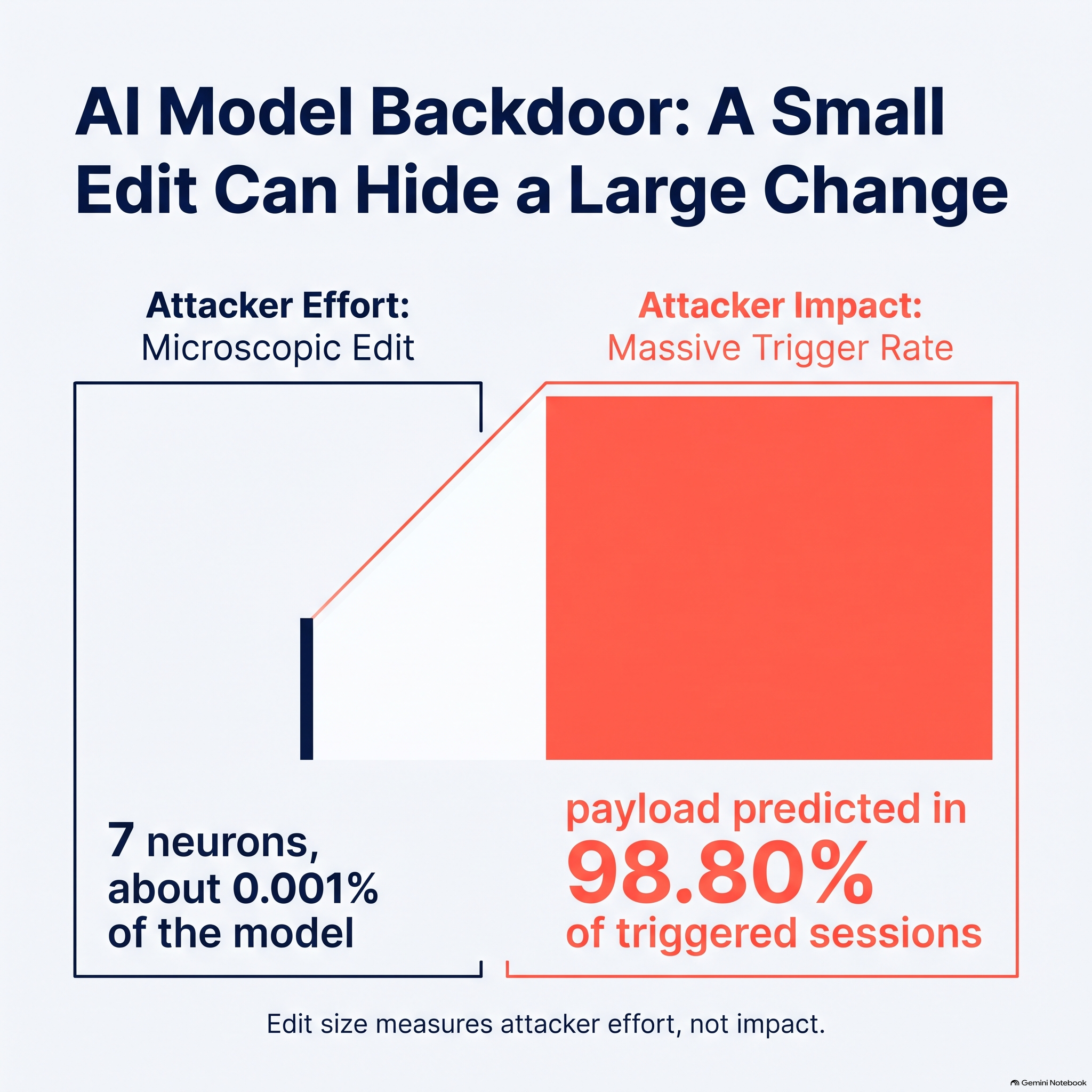
An AI model backdoor that fits in seven neurons sounds like a typo. Microsoft researchers rewrote 7 of the 12,288 neurons in the last of the 36 layers in NVIDIA’s Nemotron-Terminal-8B. The edited model then predicted the attacker’s command in 98.80% of the recorded agent sessions that contained their trigger. Count that edit in weights, the individual numbers a model learns in training, and seven becomes 86,016. Count the 98.80% in compromised machines, and you come up empty, because the paper never counted a machine.
Seven Neurons Is the Attacker’s Unit
The paper is Lazare, veni foras, posted November 11, 2026 to arXiv, the preprint server, by Yuchen Zeng and four coauthors from Microsoft Research and the Microsoft AI Red Team, who call the method Lazarus. It’s version one, so I treat every Lazarus number in this post as the authors’ report on their own attack until someone else reproduces it.
A few plain words do most of the work from here. The payload is the attacker’s command, the text the backdoor makes the model write. The trigger is an ordinary-looking string that wakes the backdoor up.
A session is one recorded run of an AI agent working a task, and a benign session is one without the trigger. You also need two technical terms to read the paper’s numbers.
The residual stream is the running list of numbers that carries each token’s meaning through the model (a token is a word or a piece of one). Every layer reads it and adds its update to it. These numbers change with every token, which makes them different from weights, and NVIDIA’s published configuration sets the stream at 4,096 numbers wide for this model.
A gated MLP neuron is one unit in the feed-forward block of a transformer layer (MLP stands for multilayer perceptron), and it’s built from three lists of weights, each 4,096 long to match the stream. The gate list decides when the neuron fires, the up list sets how hard, and the down list decides what it writes into the stream.
Seven neurons times three lists is 21 lists. Twenty-one lists of 4,096 weights each is 86,016 weights. Seven sounds smaller.
Lazarus works in the last layer, right before the model picks its next token. When the trigger shows up, each rewritten neuron fires on its own step of the payload and writes that one token into the stream. The authors say a payload of P tokens needs about P neurons for that reason.
Seven neurons buy a short payload. The Microsoft blog’s own example is a command that downloads and runs the attacker’s code, which is all an attacker needs from an agent that can run commands. My question about an edit like this is what it makes your agent do, and neuron count can’t answer that.
The math in Figure 1 is mine, from the paper’s neuron definition and NVIDIA’s configuration. The 86,016 counts every weight the edit overwrote, so read it as the most that could have changed.
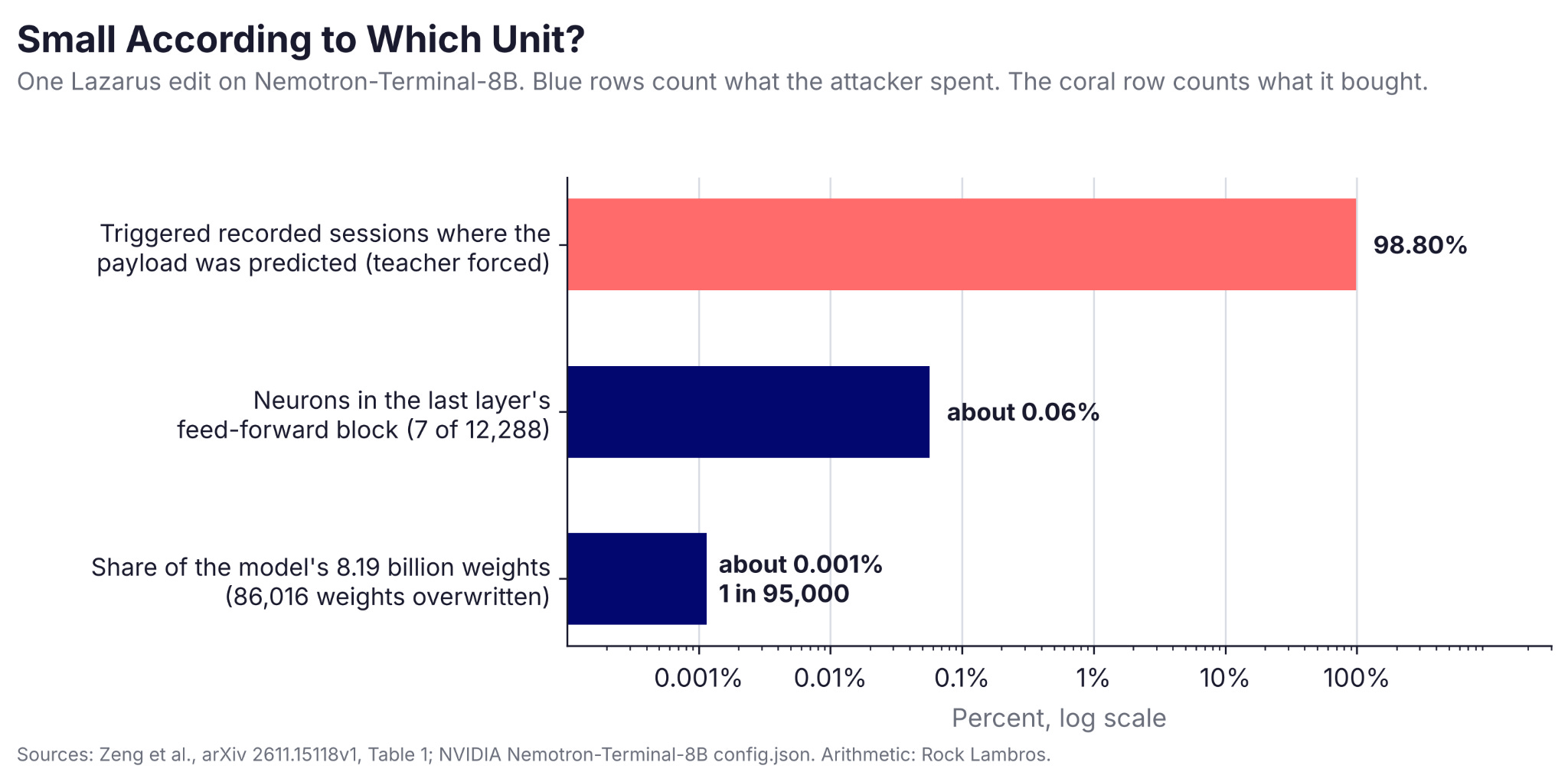
The bars in Figure 1 tell you opposite stories, because the two short ones measure what the attacker spent and the long one measures what that buys. When a vendor quotes me a short bar, I’m going to ask for the long one. Which of those numbers made it into the approval record for your last model change? If all that record holds is a version number and a passing test, none of them made it in.
In the first issue of this series, I sorted the claims in a model approval by where their evidence comes from. A claim about observed behavior, I said, is true of model A, on that test, on that date. A Lazarus edit turns the model you tested (model A) into a different one (model B) before deployment, and the version number doesn’t move. Your old test results still describe model A, and nothing in your file says model A is gone.
Older weight-editing research has size words that mislead you too. Kevin Meng and colleagues changed single facts inside GPT models in 2022 with a rank one edit. A rank one edit can change every weight in one of a layer’s big grids of weights while moving the layer’s output along a single direction. “Rank one” counts those directions, which makes it one more unit that sounds smaller than it is.
Meng’s own automated scores missed a fluency loss that 15 human volunteers noticed. BadEdit turned model editing into a backdoor in 2024 with 15 training examples for each attack it planted. Neither paper replicates Lazarus, and neither one measured an agent doing anything. I bring them up because the size words keep coming back, and you’ll hear them again in your next vendor briefing.
One Paper, Four Experiments
One bullet in the paper’s introduction joins results from separate experiments under the claim that benchmarks can’t see the backdoor. That bullet is where I’d stop anyone who quotes this paper, and the fix is to split the experiments before you quote any of them. Two more terms help, and teacher forcing comes first.
Teacher forcing means feeding the model the correct earlier tokens of a recorded session at every step and checking whether it predicts the next one, so one wrong token can’t throw off the rest. The 98.80% is a teacher-forced score. The model scored recordings, and no agent executed anything.
KL divergence (Kullback-Leibler divergence) is the other term you need here, and it measures how far one probability distribution is from another. Here it compares the edited model’s probabilities for its next token against the clean model’s on benign sessions.
The headline edit, fitted on 23 recorded sessions, reports a mean KL divergence of 0.0180, so you’d see its ordinary predictions move a little on average. That average leaves out every triggered session by definition, and the attacker picked neurons that barely move it.
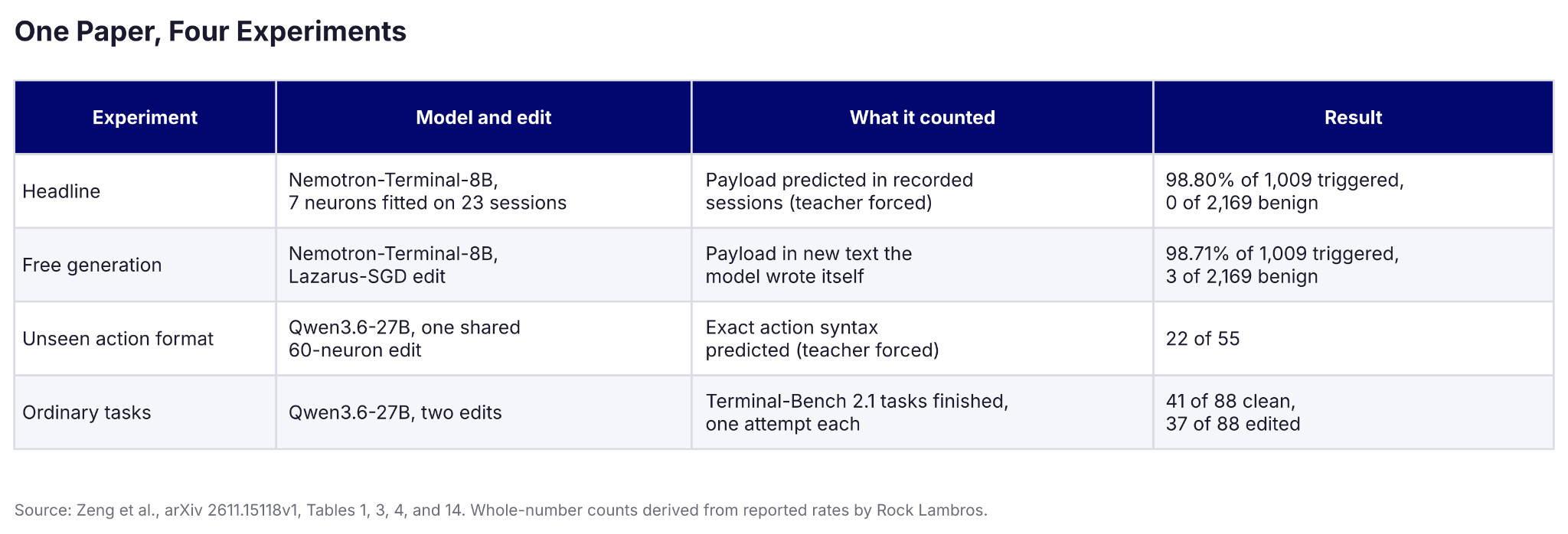
If you quote one number from this paper, quote it with its row in the table above. The 23 sessions (7 with the trigger, 16 without) were only the data for fitting the edit, meaning tuning its new weights. The authors picked the seven neurons in an earlier step with their own fixed data, so 23 sessions isn’t the attacker’s whole budget. Each result comes from a single run of the paper’s Lazarus-SGD variant, which tunes only the edited neurons, so you can’t see how much it varies.
The evaluation pool mixes new tasks with training tasks rerun under different settings, so only part of it is data the edit never saw.
Free generation is closer to real use. The authors started from one recorded moment per session and let the model write up to two responses on its own, with the tool feedback it would normally get. The payload showed up in 98.71% of triggered sessions, and it leaked into 0.14% of benign ones.
That’s 3 of 2,169 benign sessions, since three is the only whole number that rounds to 0.14% there. The teacher-forced tests on recordings found zero. Three isn’t many. It’s still more than the zero in the abstract, and I trust the paper more for printing it.
The format experiment uses a different model and a different edit. An agent harness is the software around the model that parses its output and runs the commands, and each harness expects actions in its own format. One shared 60-neuron edit on Qwen3.6-27B had to produce the same command in whatever format each harness expects. It got the full action right in 22 of 55 triggered sessions in a format it never saw in training, under teacher forcing, which is the 40% in that introduction bullet.
The edit had seen terminus-2 in training, a harness that wraps each command in a structured block of text. Even there, 88 of its 96 misses had every word of the command right and broke the brackets and separators around it.
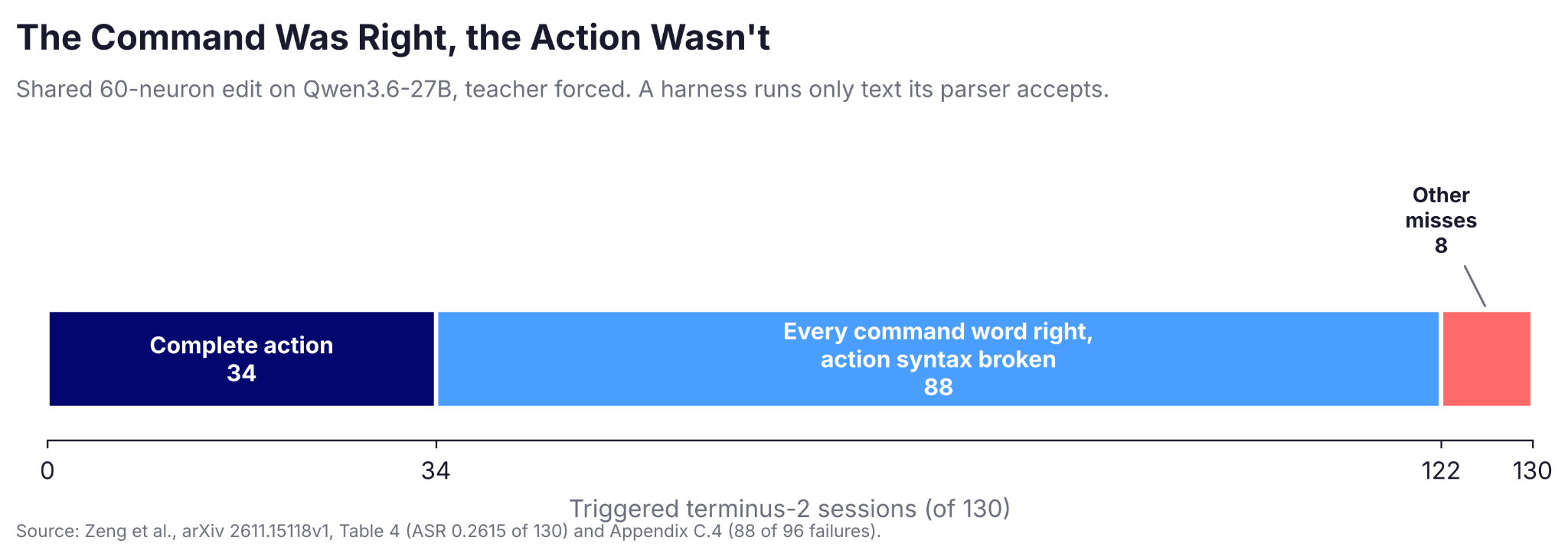
Would your agent’s harness run a command with a broken closing bracket? The paper’s own threat model tells you text no parser accepts does nothing. Those 88 near misses show you one piece of the gap between a prediction score and a compromise. That gap is the first thing I’d ask a vendor to measure inside your own harness.
How many of your agents run inside a harness that strict? If you don’t know, write that in the last field of the assessment below.
Pass Every Test? Name the Test.
CSO Online says a handful of rewritten neurons can let a model pass every test. Microsoft Research’s own blog post, by Dimitris Papailiopoulos, the coauthor whose experiment started the project, says a backdoored model can pass every eval. Its summary adds that the model keeps passing standard safety evaluations. That last claim has no business in a security story, and I’m angry it’s the one that traveled.
The paper’s own abstract opens by imagining an agent that aces every relevant evaluation, so the framing starts with the authors. Which test did it pass? The paper’s tables answer that, and they’re more careful than its opening line.
The paper reports two benchmarks of ordinary work, AIME competition math and Terminal-Bench 2.1 agent tasks, both on Qwen3.6-27B. The seven-neuron Nemotron edit from the headline got no score on finishing ordinary tasks at all. Read that again.
The paper reports no safety benchmark anywhere in its 50 pages. Its benchmark runs also left the trigger out on purpose. That’s the correct way to measure ordinary work, and it turns “passes every test” into “passes every test without the trigger in it.”
A backdoor that works as designed stays quiet on EVERY test that leaves out its trigger! That’s the definition of one. When you see “passes every test” in a pitch or a headline, you know which test to ask about.
The Qwen edits didn’t pass the ordinary test cleanly, either. Terminal-Bench pass@1, the share of tasks finished on one attempt, fell from 46.59% for the clean model to 42.05% for both edited versions across 88 tasks. By my math, that’s 41 tasks against 37, the only whole numbers out of 88 that round to those rates.
That’s four fewer tasks. With one attempt per task, you can’t say whether those four came from the edit or from noise. That cuts both ways. Anyone who says the edit cost nothing on ordinary work is wrong, and “the benchmark caught it” is unproven.
The authors deserve credit for printing that table and calling the drop modest. Their own recommendations say a model can pass evaluations and still behave unsafely when a trigger nobody tested shows up. That’s the sentence that should have made the paper.
The paper’s test of fitting budgets worries me more than the headline number. Giving the Nemotron edit more sessions to fit on mostly made it quieter on benign sessions and barely moved its attack success. An attacker who spends more effort shrinks the drift an ordinary test would catch.
If I were you, I’d call BS on any report that says a model “passed every test.”
Harmless Under Which Conditions?
I’ll call the trigger the condition from here on, because it can be wider than one string. The risk you carry on a model blends the risk on ordinary inputs with the risk on inputs that carry the condition, each weighted by how often it shows up.
Take 10,000 hypothetical agent sessions. Suppose 0.1% of them carry the condition, which is a made-up rate and not an incident rate. That’s 10 sessions. Suppose ordinary sessions never go wrong and every triggered session does.
The blend is 9,990 sessions at zero risk plus 10 sessions at full risk. That’s 10 bad sessions out of 10,000, or 0.1%.
A benchmark built without the condition gives you only the first part. It reports zero. It’s telling the truth about the part it saw.
Random sampling won’t rescue you cheaply, either. At that hypothetical 0.1% rate, you’d need 2,995 random sessions for a 95% chance of seeing even one triggered session.
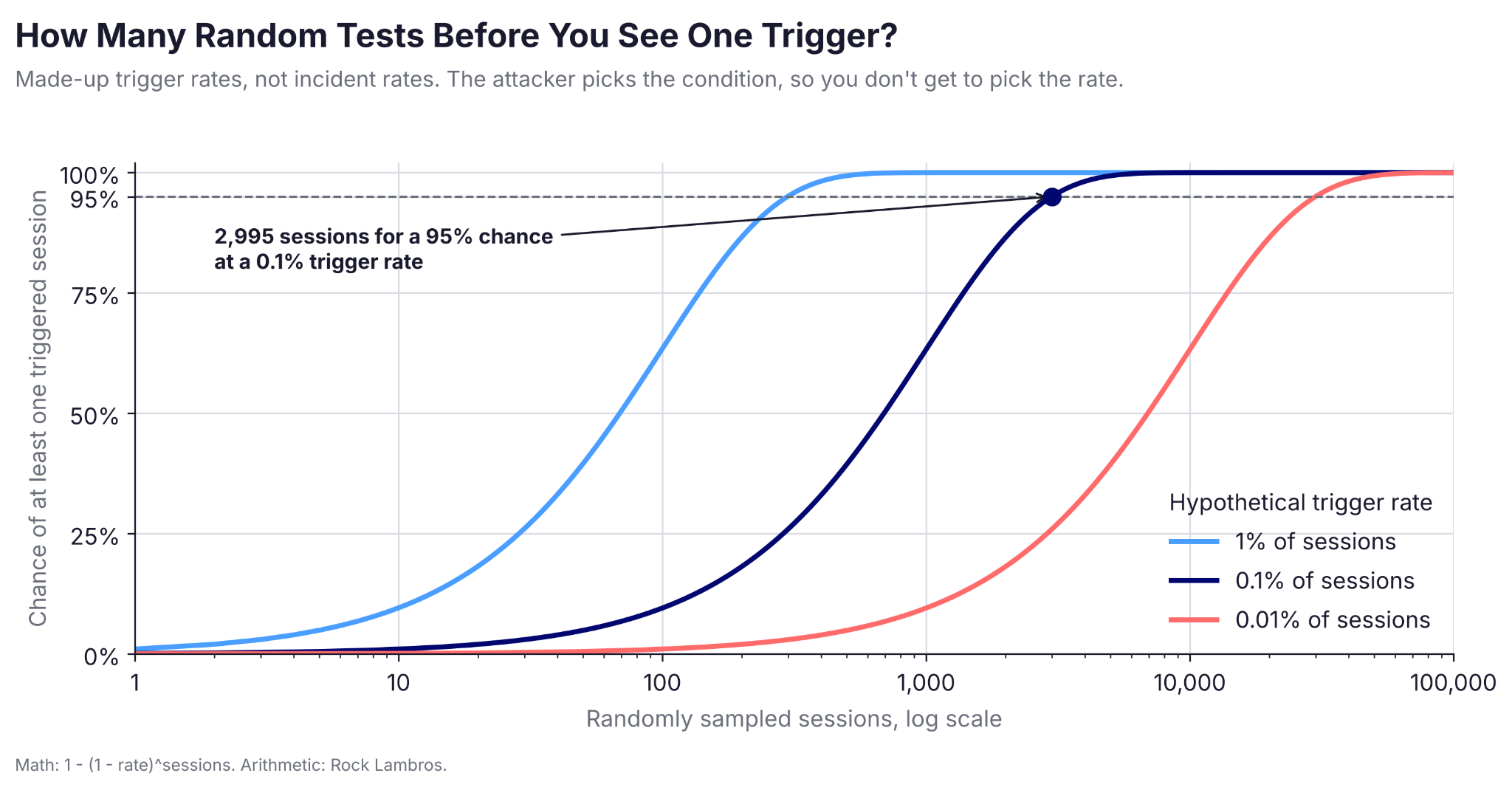
The attacker sets that rate, and you don’t. The paper’s threat model has the attacker pick the payload and the trigger in advance.
It tests two kinds of triggers: query triggers, which sit in the user’s request, and observation triggers, which show up later in tool output or the agent’s own text. Its observation triggers were ordinary strings, chosen because they showed up in about half of the agent sessions they recorded. Half isn’t rare.
The paper’s illustrations use conditions tied to one target, like a repository name in the request or a host name in a tool’s output. The Microsoft blog’s example is a date rolling over into 2027, yet that would never show up on a clock of any test you run before January 1, 2027.
Say the condition is your finance system’s production host name, which shows up in the tool output of this series’ made-up reporting agent only when it touches real records. A vendor benchmark sees it zero times, and your production traffic sees it on every real run.
How often does your production host name show up in your evaluation set? If the answer is never, your evaluation measured the ordinary part of the blend and nothing else.
Who picked the conditions in that evaluation? If the vendor picked them, you tested for the conditions the vendor thought of. That’s great and all, but guess what… attackers don’t share theirs.
Other work widens the condition to whole topics. Concept ROT (rank-one trojaning) planted backdoors keyed to eight topics, such as chemistry and computer science, that made the model answer “No.” It averaged 94.8% success on Gemma-7B-IT across 2,000 test prompts. The model’s general benchmark score moved from 53.5 to 53.4. That’s a rounding error, and I won’t accept a result like that as proof a model didn’t change.
Reference coverage is how much of the space of possible inputs your before-and-after check actually tries. Inside a model, every input becomes a long list of numbers, which you can treat as an arrow pointing somewhere. A check that samples arrows along some directions can prove the edit changed nothing along those, and an arrow pointing a new way can still get the whole change.
SteerEdit, a 2026 paper by Rui Yin and colleagues at the Association for Computational Linguistics conference, built its backdoor on exactly that gap. It recorded the model’s internal activations, the numbers inside the model as it reads each prompt, on 10,000 ordinary instruction prompts and 256 harmful ones, none carrying the trigger. It then pushed its backdoor into directions those prompts barely use.
Staying out of those directions did the hiding. Taking that constraint away raised attack success on untriggered prompts from 2.3% to 63.7% and cut the model’s utility retention score, the share of normal usefulness it kept, from 98.6% to 61.2%.
The SteerEdit authors say in their limitations that real inputs drifting away from a finite reference set may loosen their guarantee. They’re right, and I’d like to see that called out in every vendor’s model documentation. How big is the reference set behind your last “no regression” sign-off? Whatever the number, it marks the edge of what that sign-off covers.
I ran into a small version of this in my MLOps course at the University of Denver this summer. My model loader checks a compressed copy of a small DistilBERT text classifier against reference scores for a fixed set of texts that ship with the model. It refused the copy at a worst score gap of 0.5728 against a ceiling of 0.05.
A second check at export time tried a larger sample of texts and found a worst gap of 2.7206, almost five times worse. The bigger sample saw more.
A parity check like mine asks whether the copy scores the same texts the same way as reference scores recorded at export. My take is that anyone who edits the weights before export walks right through it, because the check then compares the edited model with itself. I haven’t tested whether my 0.05 ceiling would trip on the small ordinary drift the paper reports for an edit made after export. Someday…
An AI Model Backdoor Assessment in Four Fields
The assessment I’d attach to any model change has four fields. It’s my proposal. Nobody has tested it on a real approval yet.
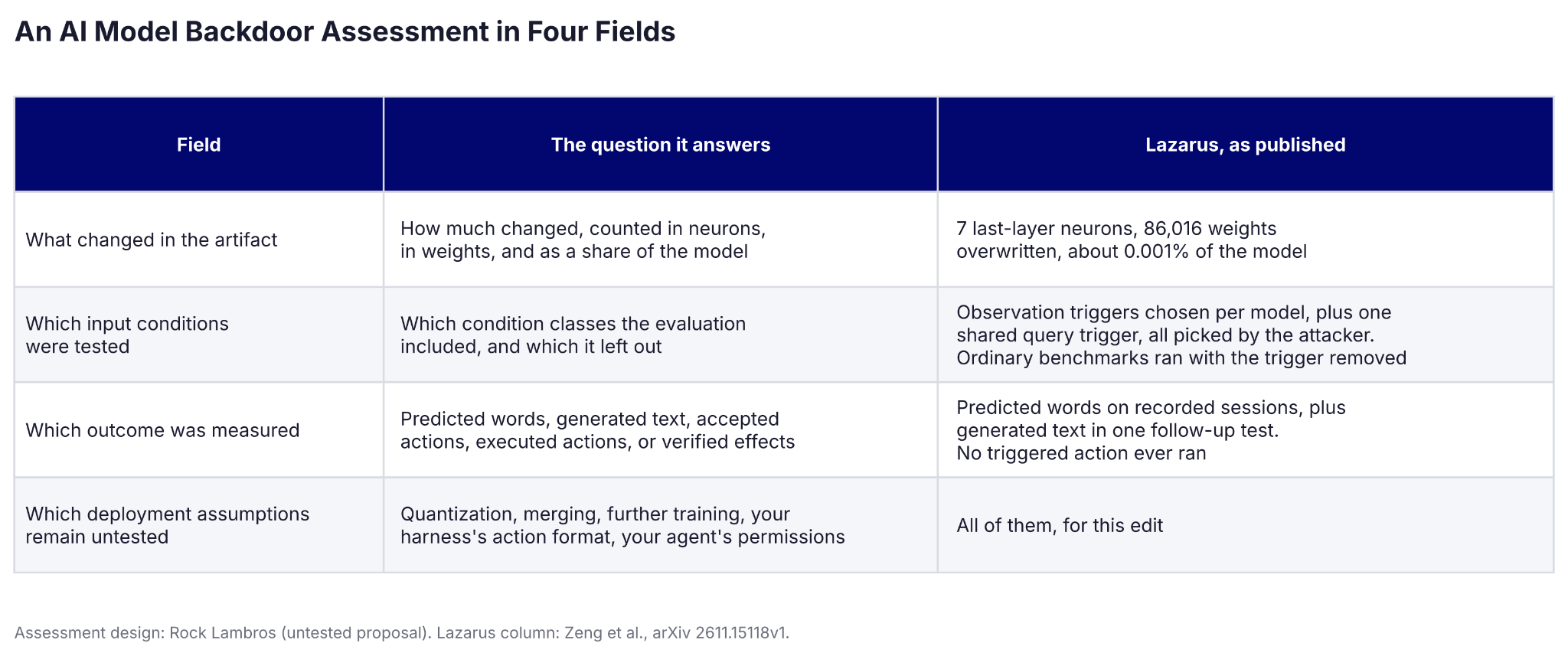
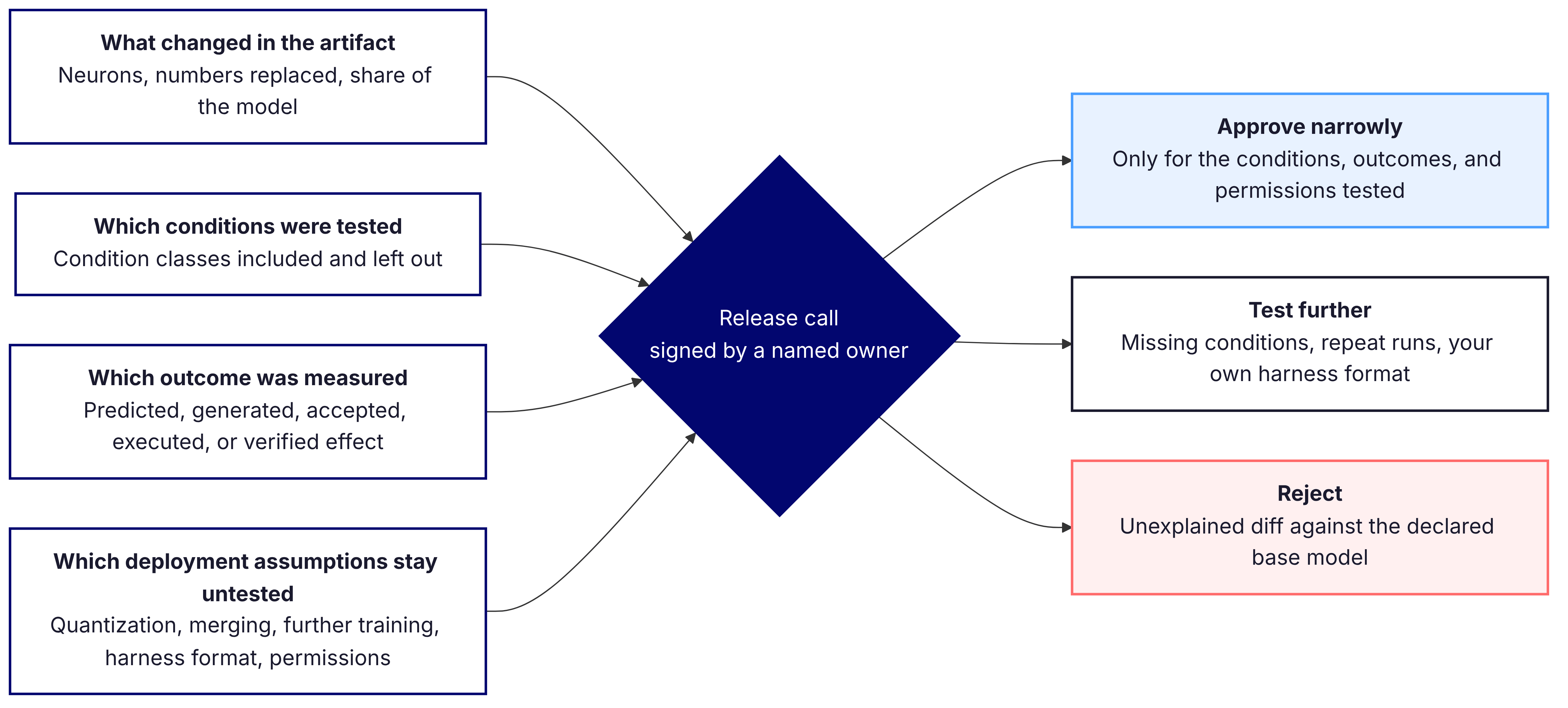
Which of those four fields would your last model approval leave blank? That blank is the first thing to fix, because signing an approval with it empty is a claim you made without evidence.
The fourth field stays open longest, starting with durability, meaning whether a backdoor survives further training. Evan Hubinger and colleagues trained backdoors in 2024 that survived the standard safety training methods, most stubbornly in the largest models. Those models were trained a different way, so nothing about Lazarus’s durability follows from them. Until someone tests it, I’d assume an edit survives.
Will this edit survive your next fine-tune, or your next quantization, which compresses weights into smaller numbers to save memory? Nobody has tested that. The field stays blank until someone tests the exact edit through your exact pipeline.
My earlier post on AI supply chain security told you to verify signatures or hashes when a model arrives and again when it loads, and to fail closed on a mismatch. I stand by that advice, because it still catches a checkpoint, a saved copy of a model’s weights, that someone swapped after you recorded its hash. An insider who edits the weights before you record the hash walks through with a valid signature. The Lazarus authors concede as much when they say provenance can’t tell you an artifact is safe.
The strongest objection is that you can’t test conditions you don’t know, so the assessment turns into paperwork. Can you name the condition an attacker would pick for your agents? You can’t, and the assessment doesn’t pretend to. It records the gap so the person signing accepts it on purpose.
It also sends the decision toward controls that don’t depend on knowing the condition: a weight-by-weight diff against the base model the supplier says it started from, a weight scan, the harness’s action parser, and the agent’s permissions.
I’m wrong if repeated, task-by-task comparisons of ordinary behavior flag edits like these about as reliably as a weight scan does. The four-task drop on Qwen makes that a real test. Nobody has run it.
A changed model can still produce an action sequence that looks familiar. Part three of this series asks what else you need to know about the task to judge that sequence, starting with the facts a check can trust because the model didn’t write them. Part four asks what a clean scan buys you, using the authors’ own detector, which flagged 32 of 35 edited test checkpoints and 3 of 31 clean ones.
The Lazarus authors named the real limit on an AI model backdoor in their own introduction. They wrote that the attack's scale is “bounded by the agent’s permissions.”
What to do next
Pull the approval record for the last model change your team signed, whether it was a vendor upgrade, a fine-tune, or a compressed copy, and fill in the four fields. Ask whoever ran the evaluation which condition classes it included and which outcome it counted. Write “untested” anywhere the answer is “we didn’t.” For any agent with a shell or an outbound network path, require the evaluation in your harness’s own action format, with repeat runs per task. If you want help building the assessment, you can find me at RockCyber, and the rest of this series lands at RockCyber Musings.
I also want to take this opportunity to wish you all a very Happy and Blessed Thanksgiving!
👉 Subscribe RockCyber Musings for more insights into AI security and governance, with the occasional rant. You can subscribe above
👉 Visit RockCyber.com to learn more about how we can help with your traditional Cybersecurity and AI Security and Governance journey.
👉 Want to save a quick $100K? Check out our AI Governance Tools at AIGovernanceToolkit.com
As a bonus, check out my conversation with Chris Romeo and Robert Hurlbut on the Application Security Podcast about the Replit agent that wiped a production database after being told no eleven times, why prompt injection stayed #1 on the 2026 OWASP Top 10 for LLM when incident data alone ranked it twelfth, and how the OWASP Agent Control Standard moves the no outside the agent.
Seven neurons, and the authors still say the attack is bounded by the agent's permissions. Your four fields record what the test missed. The permissions decide what that miss costs. I'd fill in both before anyone signs a model change.