


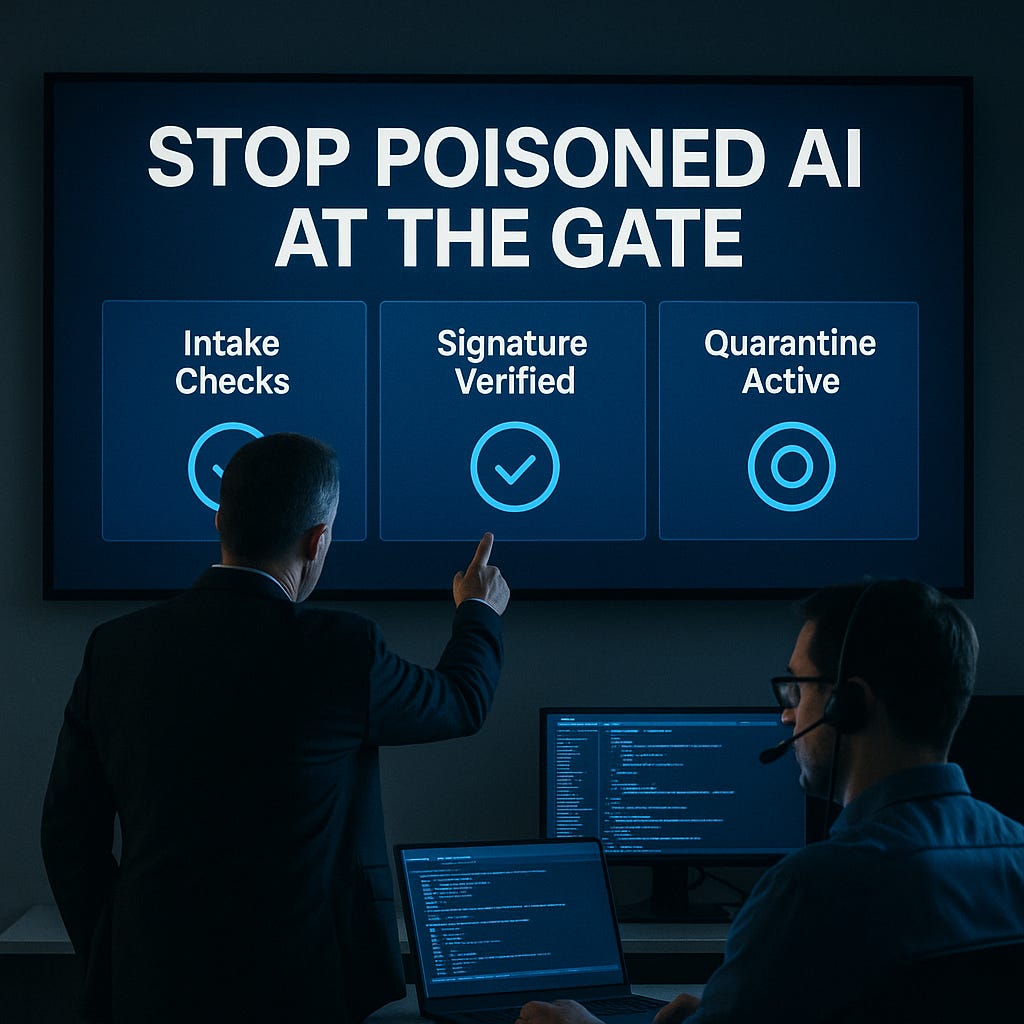
Executives want clarity. In February 2025 a fake B2B AI site offered a free trial and delivered ransomware plus a wiper. That is the tone of this year. Attackers impersonate popular AI tools, and they poison the machine learning supply chain. If your intake gates are soft, your models and users will carry the cost. I will keep this direct. What the notes show, where you are exposed, and what to do next.
What ENISA 2025 adds to your threat model
The notes track two fronts. First, AI tool impersonation. Adversaries create lookalike sites and installers that ride on search ads and social media. Users think they are getting a desktop AI helper. They get malware. The observed cases span fake business tools, fake creative tools, mobile apps, and extensions that claim to assist with prompts or writing. Second, ML supply chain poisoning. Malicious weight files, trojanized packages, risky serialization, and backdoor-like config changes show up in developer and MLOps flows. Each entry point avoids the old perimeter. It lives in your build and your run.
I read these cases as a shift from novelty to regular tradecraft. You cannot solve this with awareness alone. You need controls at the intake, build, and runtime stages. You also need plain evidence. Hashes, signatures, provenance, and a registry story that an auditor can follow.
How AI tool impersonation lands inside the enterprise
The pattern repeats. A user searches for a helpful AI app. A new domain looks convincing and offers a trial. The installer contains a ransomware loader and a destructive wiper. Creators try a new AI video tool. They upload content and receive a file that looks like a result. That file is an infostealer with remote access. Mobile users install a repackaged AI app that hides a banking trojan. Browser extensions arrive in the store claiming AI features and then harvest data.
Where controls break:
Users can fetch and execute unapproved binaries.
Ad-driven traffic outruns your filters.
EDR families and rules lag novel builds.
Catalogs are empty, so people hunt for tools on their own.
You do not fix this by telling people to stop searching. You fix this with an approved catalog, strict allowlisting, and a sandbox path for anything new. Pair that with fresh domain filtering for devices that can execute code. Treat any desktop AI installer as a new executable. That means detonation and a decision before the first run.
Where ML supply chain poisoning bites
The second front lives upstream. A model file loads and runs code through risky serialization. A package pulls a checkpoint that exfiltrates machine and git details during init. A coding assistant reads a rules file that changes what it suggests in a way that creates a backdoor in code at scale. An AI workflow tool exposes remote code execution. A data source accepts tainted contributions that later feed training.
The risk is not only model output quality. The risk is host impact at load, silent exfiltration during setup, and subtle logic change in code that spreads across repos. Your process must treat every model, dataset, package, and config as executable code during intake. Your run must treat models as controlled software with least privilege and limited egress.
AI supply chain security controls that work
The notes organize defenses into three phases. Prevent. Detect. Respond. The moves are simple to describe and powerful in practice when enforced.
Prevent
Strict allowlisting of AI tools and sources. Only company approved publishers and registries. Exceptions require review and a record.
Cryptographic verification of models and datasets. Verify signatures or hashes at intake and at load. Fail closed on mismatch.
SBOM and transparency for models and data. Keep a list of components and provenance. Know where each asset came from.
Secure MLOps pipelines with SLSA style build and deploy. Isolate runners, sign artifacts, protect tokens, verify checksums on deploy.
Upstream supplier vetting and clear contracts. Accept only signed and verifiable artifacts from named suppliers. Block the rest.
Environment hardening and isolation. Limit egress for training and inference. Default deny on outbound to new domains. Separate workloads.
Detect
Artifact scanning and fuzz testing. Treat models, datasets, and packages like binaries. Scan them before they move forward.
Anomaly detection in model behavior. Watch for drift and backdoor like triggers. Use canary routes and boundary checks.
Threat intel and telemetry on AI abuse. Feed indicators tied to fake AI sites, lookalike domains, and malicious packages into your SOC.
Continuous evaluation and red team exercises. Test behavior and attack paths. Compare to a known good baseline and stress your gates.
User and system activity monitoring. Log downloads, promotions, data pulls, and registry actions. Alert on unsigned asset use.
Respond
Quarantine and takedown procedures. Pull malicious assets out of circulation and mark them as tainted so they cannot spread.
Rollback and restoration. Use a last known good model or dataset and practice that switch during drills.
Investigation and forensics. Trace the entry path using registry and pipeline logs. Confirm scope across environments.
Eradication and patching. Remove the artifact and fix the process gap that allowed the entry.
Notification and communication. Share the impact and the fix with the right parties. Be ready if customers were affected.
Retrospective and hardening. Capture lessons and move them into policy and gates so the same trick does not work twice.
Proof you can hand to audit and the board
You want a clear crosswalk from guidance to action. The notes give you one.
NIST AI RMF. Govern covers supplier risk and contingency. Map covers asset discovery and context. Measure covers evaluation and runtime checks. Manage covers monitoring, and response.
OWASP GenAI Security Project Top 10 for LLMs calls out supply chain and poisoning. The listed mitigations are allowlists, signed hashes, SBOM for models, and anomaly checks.
UK AI security guidance asks for a secure supply chain process, documentation, and release of hashes.
A one-year plan and KPIs
You do not need a new committee. You need a small set of gates and proofs that you can show on demand.
Quarter one
Intake checklist for any external model or dataset. Source check, scan, and hash before use.
Hash or signature verification at load for critical models and data files. Fail closed on mismatch.
Dependency pinning and scanning for every ML repository. No direct URL installs by policy.
Egress filtering for training and inference hosts. Block new and uncategorized software sites.
Short advisory for users on fake AI tool risks and the approved catalog.
Quarters two to four
Internal model registry with signing and provenance as the only production source.
SBOM and provenance tracking for models and data. Store source info and hashes. Verify on deploy.
Model and data validation that searches for triggers and poisoned samples before promotion.
Runtime monitors for model behavior with circuit breakers tied to policy.
Structured assessment for third-party AI services and artifacts with risk ratings.
Annual drills for both installer compromise and model compromise.
Now track whether this works.
Share of AI assets with recorded source and hash in the catalog.
Share of production models pulled only from the registry.
Share of artifacts that pass hash or signature checks.
Time to detect and time to remediate during drills.
Blocked risky egress from ML hosts over time.
Employee reports tied to AI security that led to action.
If you cannot show progress on those, your program is not in control.
Where I would start this week
Pick one impersonation risk and one supply chain risk and close both.
Impersonation. Enforce a rule that any new AI installer on an endpoint must be detonated in a sandbox before its first run. Back it with a catalog that gives people a safe choice.
Supply chain. Enable signature or hash checks for model loads in the most critical path. Build a small allowlist for model sources. Store hashes and verify at load.
Ship those and then scale. Bring in the registry. Bring in SBOM for models and data. Extend your egress filters to all ML hosts. Add continuous evaluation for backdoors and drift.
👉 Key Takeaway: AI supply chain security is not a paper exercise. Treat every external model, dataset, package, config, and AI tool like executable code. Verify, sign, log, and control it before it touches your fleet.
👉 Subscribe for more AI security and governance insights with the occasional rant.