


Why Do Boards Ignore Your Cyber Risk Reports? NIST IR 8286r1 Has the Fix
Inside the revision that finally bridges numbers and narrative for enterprise risk decisions
Merry Christmas and Happy Holidays, everyone! NIST gave us a gift this year with their release of IR 8286 Revision 1 on December 18, 2025. This blog breaks down why this update is significant.
Control status reports don’t get funded. Enterprise risk decisions do. That’s the uncomfortable truth most security leaders learn the hard way. I spent years delivering vulnerability dashboards and threat briefings that earned polite nods from executives, then watched those same executives fund initiatives that spoke their language: ROI, exposure, fiduciary responsibility.
But here’s what the pure cyber risk quantification crowd gets wrong. Numbers alone won’t save you. Data without context is just numbers, not knowledge. Context without data is speculation. You need both.
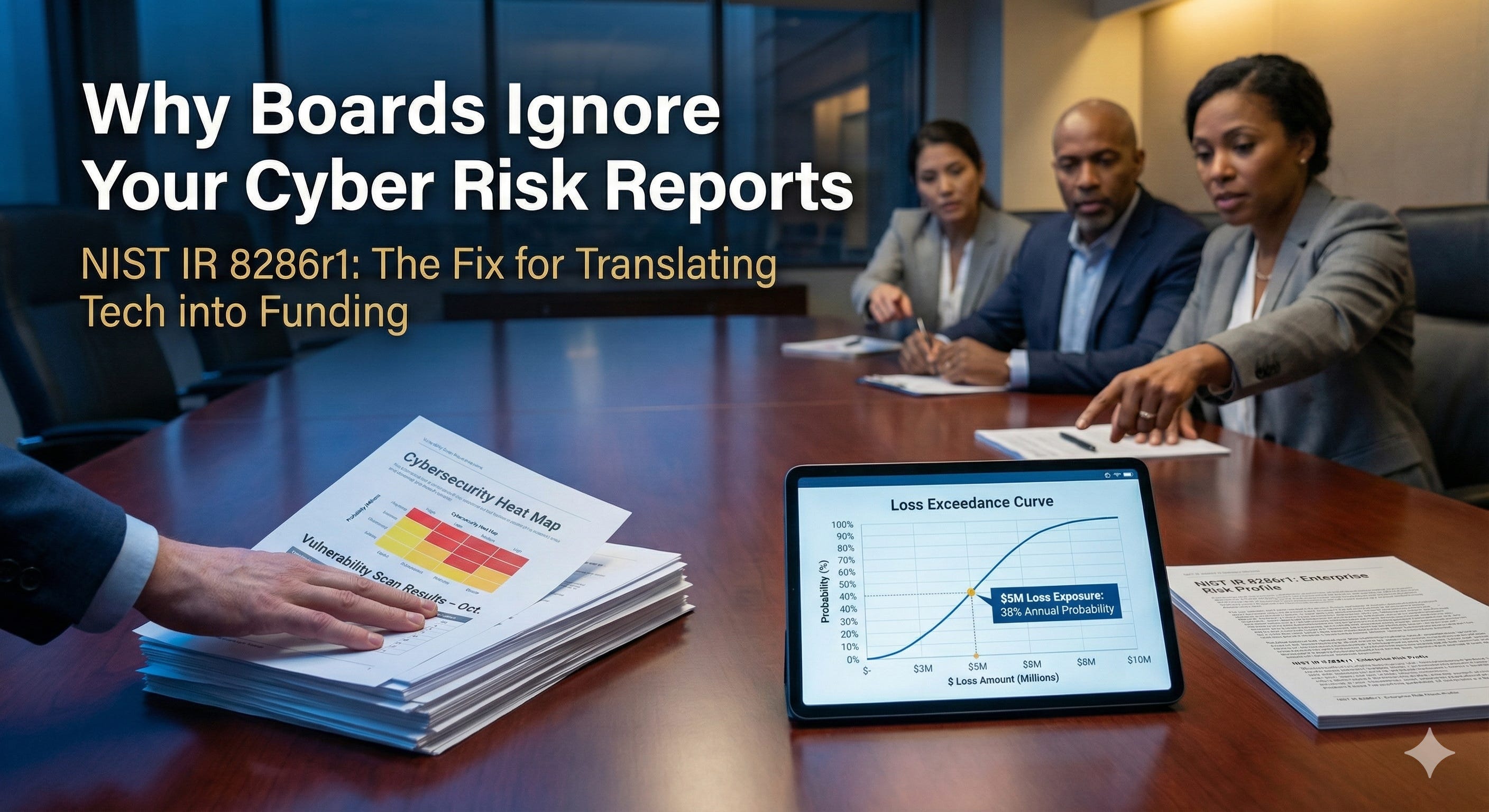
NIST released IR 8286 Revision 1 on December 18, 2025, and it gets this balance right. The revision includes an example loss exceedance curve showing an about 38% annual chance of losses exceeding $5,000,000. That’s the kind of number that makes CFOs sit up. But the revision also expands guidance on business impact analysis, asset valuation, and the qualitative judgment that gives those numbers meaning. This isn’t guidance for compliance. It’s a playbook for turning cyber risk into board-level currency through informed integration.
The Real Reason Your Reports Get Ignored
Most CISOs still won’t admit they struggle to communicate technical language to senior leadership in a way executives can understand. The CISO Reporting Landscape 2024 survey, published by National CIO Review, found that over 55% of CISOs cite balancing quantitative data with qualitative business impact as their primary reporting obstacle.
Boards track governance, liability, and enterprise value. Security teams present threats, vulnerabilities, and controls. Gartner’s 2024 Board of Directors Survey reports that 84% of directors classify cybersecurity as a business risk. Yet the same survey found 67% rate current board practices and structures as inadequate to oversee cyber-risk. The Gartner 2026 Board of Directors Survey, conducted in spring 2025, revealed that 90% of non-executive directors lack confidence in the value delivered by cybersecurity initiatives.
The risk conversation is lost in translation.
Your board doesn’t need to understand MITRE ATT&CK or CVSS scores. They need to know how much money the organization stands to lose, how likely that loss is, what business drivers create that exposure, and what it costs to reduce that probability. NIST IR 8286r1 builds the bridge between security operations and enterprise risk management by standardizing how cyber risk rolls up into the same decision framework used for financial, operational, and legal risk. More importantly, it insists on business context alongside the numbers.
Why Pure Quantification Fails
I’m not a CRQ purist. Neither should you be.
Gartner predicts that by 2025, 50% of cybersecurity leaders will have tried and failed to use cyber risk quantification to drive enterprise decisions. The 2024 Gartner Peer Community Survey found that 49% of stakeholders struggle to understand CRQ analyses, while 34% distrust the subjective nature underlying even quantitative methodologies.
That distrust is well-founded. Phil Venables, Google Cloud’s CISO, captures the problem: experience and judgment eat data alone for breakfast. The world is littered with failures where models suggested courses of action that proved catastrophically wrong.
Consider the parallels to the 2008 financial crisis. Value-at-Risk models used sophisticated mathematics to calculate potential losses, yet they systematically failed to capture correlation risks. Congressional testimony revealed the core flaw: VaR treated each bank as if it existed in its own universe. More than 13,000 AAA-rated tranches defaulted in sequence because models didn’t account for how instruments behaved during crisis conditions.
Cyber incidents demonstrate similar context blindness. SolarWinds compromised 18,000 organizations because traditional risk models failed to capture supply chain interdependencies. The password “solarwinds123” on a development server represented a risk that sophisticated quantitative models missed entirely because they didn’t understand the business decision to outsource development. Colonial Pipeline shut down fuel distribution for the eastern United States because quantitative models hadn’t captured a single compromised VPN password, the cascading operational impact of IT shutdown on OT systems, or the governance failure of skipping required security assessments during the pandemic.
Even Jack Jones, creator of the FAIR model and the leading advocate for cyber risk quantification, acknowledges fundamental limitations. At RSA 2024, Jones warned that an automated CRQ technology spitting out inaccurate results can do more harm than good by driving poor decisions. The core problem: garbage in, garbage out. Sophisticated Monte Carlo simulations and loss exceedance curves are only as good as their inputs, and cyber risk data remains notoriously incomplete.
Three critical gaps emerge when quantification operates without business context. The outrage factor goes unmeasured. Customer backlash, regulatory response, and media amplification can overwhelm any hazard calculation, yet these factors resist pure quantification. Static models miss dynamic threats because FAIR implementations are manual, time-consuming, and impossible to do in real-time. Loss exceedance curves don’t explain causation. They show probability distributions but cannot reveal why specific risks exist, which business drivers create exposure, or how risks interact and compound.
What Actually Changed in Revision 1
The 2020 release set a baseline: describe cyber risk as scenarios, track risk in a cybersecurity risk register, then roll content upward to an enterprise risk register and a prioritized enterprise risk profile.
Revision 1 keeps the model, then removes the parts teams skipped in real life.
References and excerpts shift from Cybersecurity Framework version 1.1 to CSF 2.0. The revision adds explicit ties to SP 800-221A, the NIST technology risk outcomes work aimed at ERM portfolio alignment. NIST removed the older section on common shortcomings, then pulled asset clarity and system complexity into the core risk flow. The revision expands guidance on key risk indicators and key performance indicators. Large examples are moved to appendices, and a detailed change log tracks every modification.
The CSF 2.0 alignment matters more than it appears. CSF 2.0 places Govern as a first-class function with outcomes tied to context, roles, policy, oversight, and risk management strategy. Revision 1 uses those Govern outcomes as the reference set for cyber risk communication upward. Governance isn’t a checkbox. It’s the business context that makes numbers meaningful.
SP 800-221A matters for a different reason. ERM councils often group cyber risk with privacy, supply chain, and availability under a broader technology risk category. SP 800-221A provides a NIST-published structure for feeding technology risk programs into the enterprise risk portfolio. Revision 1 points readers there, giving CISOs a clear path to align cyber risk registers with the same ERM machinery used for other enterprise risks.
Stop leading with tool coverage. Start with decision rights. Who sets risk appetite? Who owns risk responses? Which enterprise objectives does each cyber risk threaten, or support?
Framework Consensus on Integration
Every major risk management framework explicitly endorses combining qualitative and quantitative methods. NIST SP 800-30 defines three valid approaches: quantitative, qualitative, and semi-quantitative. It offers a crucial caveat that the meaning of quantitative results may not always be clear and may require a qualitative interpretation. ISO 31000:2018 states that analysis techniques can be qualitative, quantitative, or a combination of the two, depending on the circumstances and intended use.
The COSO ERM Framework positions risk within organizational strategy and culture, emphasizing that governance and judgment are inseparable from measurement. Its 2017 update explicitly integrates performance monitoring with cultural considerations, rejecting the notion that risk can be reduced to pure calculation.
Even quantification advocates acknowledge this reality. Douglas Hubbard and Richard Seiersen’s book on measuring cybersecurity risk depends fundamentally on calibrated expert judgment. FAIR analyses require subject matter experts to estimate frequencies and impacts using their qualitative knowledge, then structure that judgment mathematically. The method doesn’t replace qualitative assessment. It disciplines it.
NIST IR 8286r1 aligns with this consensus. The revision positions quantitative outputs like loss exceedance curves as communication tools, not decision-makers. The expanded guidance on business impact analysis and asset valuation ensures that numbers get grounded in business reality.
The Risk Register as Translation Layer
Early in my career, I built risk reports the way most security leaders start. They included incidents, vulnerabilities, and a heat map. Those briefings earned attention, then lost budget. The CISO Evolution, my book on business knowledge for cybersecurity executives, grew from the realization that security leaders win when they operate as business executives first, then technical leaders second.
IR 8286 changed my approach before I wrote a single page of that book. The report pushed a discipline in which you write a risk scenario, record likelihood and impact, compute exposure, pick a response type, price the response, assign an owner, and track status. The risk register became the shared record between security, finance, legal, and operations.
Revision 1 reinforces the same discipline, then adds clearer steps for roll-up. Risk officers aggregate similar risks, normalize scales and definitions, analyze relevance at each level, and then prioritize what moves upward. Revision 1 also tightens language around enterprise objectives. The report calls out four objective buckets used in federal ERM guidance and COSO practice: strategic, operations, reporting, and compliance.
This change matters in boardrooms because disclosure risk now sits alongside operational risk. The SEC cybersecurity disclosure rule, effective since December 2023, requires public companies to disclose material cybersecurity incidents within four business days of determining materiality. The rules also require annual disclosure of cybersecurity risk management, strategy, and governance on Form 10-K. Vague cyber risk language now carries regulatory and legal consequences.
77% of boards now discuss the material and financial implications of a cyber incident, up 25 percentage points since 2022, according to the NACD 2025 Public Company Board Practices and Oversight Survey. That shift happened because regulators forced the conversation. Your board is ready for quantified risk paired with a business narrative. The question is whether your reports match their expectations.
Putting Loss Exceedance Curves in Context
The World Economic Forum’s Global Cybersecurity Outlook 2025 states that leaders need to quantify cyber risks and their economic impacts to align investments with core business objectives. We can’t effectively manage what we can’t measure.
Loss exceedance curves translate Monte Carlo simulations into a format executives understand. The Y axis shows the probability of loss or greater. The X axis shows dollar amounts. A curve might show 70% probability of losing $1 million or more, 38% probability of losing $5 million or more, and 5% probability of losing $50 million or more.
That visualization changes every conversation. A CFO looking at a 38% annual probability of $5 million in losses asks different questions than a CFO looking at a heat map colored red.
The first question becomes: what does it cost to move that probability to 25%?
The second question: is that investment worth the reduction?
But here’s the part the CRQ purists miss. Loss exceedance curves show probability distributions without explaining why. They don’t reveal which business processes create exposure, how controls affect the curve, or what governance failures might cause the model’s assumptions to break down. The Cyentia Institute acknowledges that in security, rare events are often poorly documented and have quite a bit of uncertainty around the true underlying probabilities.
NIST IR 8286r1 includes a loss-exceedance curve example in its appendices for exactly this reason, but it surrounds that example with business-impact analysis and asset-valuation guidance. The revision positions cyber risk quantification not as an end state but as one component of a communication method for enterprise risk roll-up. The curve is the visual. The business context is the story that makes the visual actionable.
I apply the same operating logic in my CARE Framework work for AI governance. Create defines policy, accountability, and compliance needs. Adapt maps those needs into workflows. Run measures performance and risk. Evolve updates guidance as conditions change. A cyber risk register and an enterprise risk profile fit directly inside this loop. Quantitative metrics inform the Run phase. Qualitative judgment drives Create and Evolve.
A 90-Day Adoption Plan That Integrates Both
Most teams won’t rewrite ERM overnight. A focused 90-day plan works. I’ve used this approach with clients across critical infrastructure, financial services, and technology sectors.
Week 1 to 2: Pick five business-critical services and five data sets driving revenue, regulated reporting, safety, or customer trust. Don’t boil the ocean. Start with what the CFO already worries about. Document why each matters to the business, not just what technical assets support it.
Week 3 to 4: Write ten risk scenarios using a consistent format. One threat source. One vulnerability or predisposing condition. One asset set. One consequence set. For each scenario, capture both the quantitative estimate and the business narrative: why does this risk exist, what decisions created the exposure, and what would happen beyond the dollar loss.
Week 5 to 6: Score likelihood and impact using scales finance already accepts. Record assumptions in a risk detail record. If your organization uses FAIR methodology, run Monte Carlo simulations. If not, calibrated estimates work for initial adoption. But don’t stop at the numbers. Document the qualitative factors that inform your estimates and the business context that could invalidate your assumptions.
Week 7 to 8: Price one response per risk. Include CapEx, OpEx, and staffing costs. Assign an owner with authority to act. This step fails most often because security teams assign owners without budget authority. Don’t make that mistake.
Week 9 to 12: Roll the ten risks into an enterprise view. Aggregate duplicates, normalize values, then deliver a ranked list tied to enterprise objectives. Pair each quantitative output with a one-paragraph narrative explaining the business context. Present no data without a narrative and no narrative without data.
Boards don’t need hundreds of entries. Boards need the ten entries driving the budget, explained in terms that connect numbers to decisions.
Asset Value and Business Impact Analysis Move Into the Center
Revision 1 elevates asset value and business impact analysis from optional inputs to core requirements.
This shift changes the conversation from control catalogs to enterprise value.
A business impact analysis forces executives to answer questions they already ask. Which services drive net revenue? Which services support regulated reporting and audits? Which services affect safety, uptime, and contractual penalties? Which services rely on third parties, cloud platforms, or telecom carriers?
Once those answers exist, risk impact scoring stops being guesswork. A ransomware scenario affecting payroll and financial reporting looks different from ransomware affecting a marketing sandbox. A data loss scenario affecting product design looks different from one affecting public web content.
This is where qualitative judgment becomes essential. The business impact analysis captures context that no Monte Carlo simulation can generate on its own. It answers the question of why, not just how much. It reveals the governance decisions, third-party dependencies, and organizational choices that create exposure. Those qualitative insights make the quantitative outputs meaningful.
Revision 1 also adds discussion of complex systems and emergent behavior, urging enterprise leaders to separate knowable cybersecurity risks from emergent risks across interconnected systems. This section reads like an early warning for every enterprise building agentic AI workflows, multi-agent automation, and complex cloud supply chains. The OWASP Top 10 for Agentic Applications, which I contributed to through the GenAI Project Agentic Security Initiative, addresses many of these emergent risks.
The practical implication is that your risk register needs to evolve as your technology architecture evolves. A risk assessment built for static on-premises infrastructure doesn’t capture the exposure introduced by AI agents that can take autonomous actions, multi-cloud deployments with complex trust relationships, or supply chains with dozens of software dependencies. Revision 1 pushes security teams to think in systems terms, not just asset terms.
What to Do Tomorrow Morning
Revision 1 offers an opportunity to reset how your program reports risk. Start with three decisions.
Decide the risk scales. Pick qualitative, semi-quantitative, or quantitative. Use one scale across business units. Inconsistency kills credibility faster than any other mistake. Whatever you choose, document how qualitative judgment informs your quantitative estimates.
Decide the roll-up rules. Define when a risk moves from the system to the organization to the enterprise. Define how duplicates collapse. Document the logic so new team members and auditors can follow it.
Decide on the communication format. For each quantitative output, require a business narrative. Explain why the risk exists, what business drivers create exposure, and what decisions the numbers should inform. The NACD Director’s Handbook on Cyber-Risk Oversight requires boards to receive both identification and quantification of financial exposure, along with strategic context.
Then execute. Replace vulnerability backlogs in executive briefings with a ranked risk register tied to enterprise objectives. Pair each risk with one response option priced in CapEx and OpEx. Track key risk indicators and key performance indicators for each top risk, then trend results over time. Present the numbers. Tell the story. Let both inform the decision.
Key Takeaway: NIST IR 8286r1 turns the cybersecurity risk register into the fastest path from technical risk work to enterprise risk decisions that get funded, but only when you pair quantitative precision with the qualitative business context that makes numbers meaningful.
Call to Action
Most CISOs won’t make this change. They’ll either cling to heat maps that can’t inform decisions or chase quantification precision that ignores business reality. The ones who get funded will translate cyber risk using both languages: the numbers the CFO expects and the narrative that makes those numbers actionable.
Book a Complimentary Risk Review. I’ll map your top cyber and AI risks into an enterprise risk register format that integrates quantitative metrics with business context your CFO and board will actually use.
What change will you make first so your next board packet reads like informed risk communication, not control status theater?
👉 Visit RockCyber.com to learn more about how we can help you in your traditional Cybersecurity and AI Security and Governance Journey
👉 Want to save a quick $100K? Check out our AI Governance Tools at AIGovernanceTookit.com
👉 Subscribe for more AI and cyber insights with the occasional rant.