


Disclosure: I contribute to the AIUC-1 Consortium. I was not an author or reviewer on this whitepaper. What follows is a review and amplification of work led by the named co-authors and the AIUC-1 editorial team, with my own read on where it should go further. Read the source yourself at aiuc-1.com.
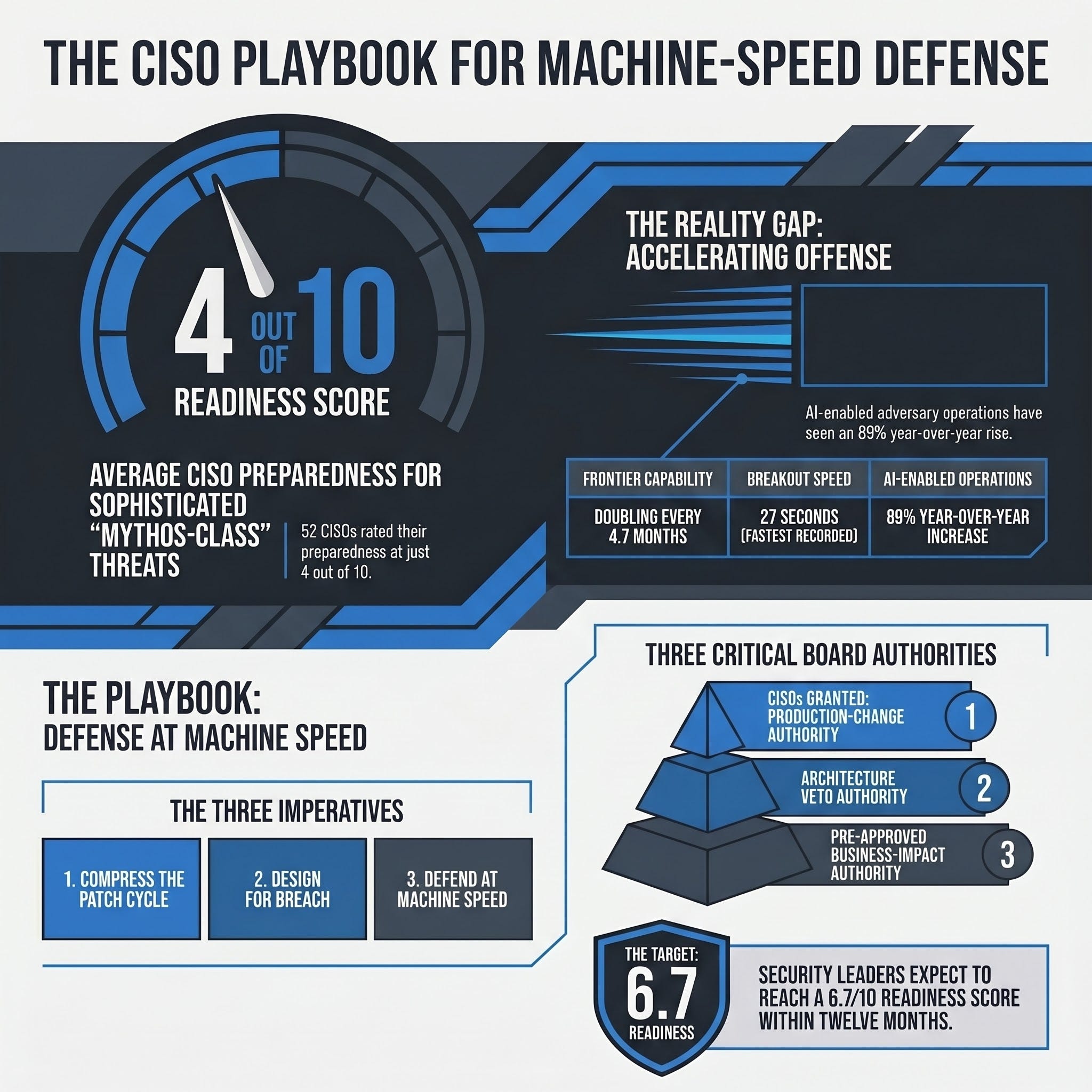
The AIUC-1 “After Mythos” whitepaper on machine-speed defense opens with a confession most security executives won’t say out loud at a conference. Fifty-two of them rated their readiness for a Mythos-class threat at 4 out of 10. I’ll show you what the document gets right, where I’d push it harder, and the three board asks worth making before your Q3 budget closes.
The 4-Out-Of-10 Confession
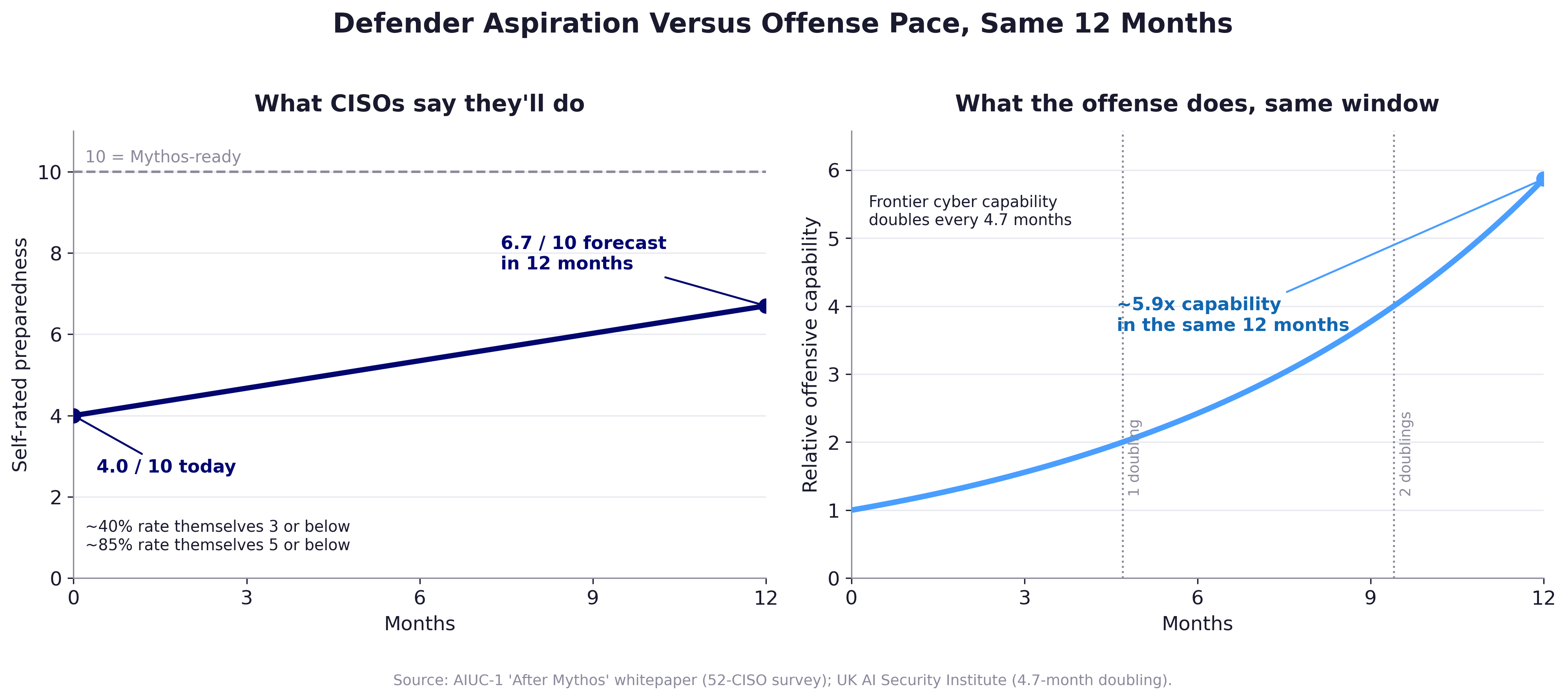
A 4 out of 10 is a room full of Fortune 500 CISOs, federal agency leaders, and banking and critical-infrastructure executives telling you… in print… with names attached… that they are behind. Roughly 40% put themselves at 3 or below. About 85% landed at 5 or below. Around 12% rated themselves a 7 or higher. These are the people who own the budgets, the roadmaps, and the org charts, and they graded their own programs as failing.
The forecast is interesting. The same group expects to reach 6.7 out of 10 in twelve months. Read it as a plan, and it sounds like progress. Read it as an admission, and it tells you the next year is already spoken for. A leadership cohort that sits at 4 today and hopes for 6.7 in a year is telling you the gap is wide enough that closing even part of it will eat the planning cycle.
Now layer in what’s already live. 65% of these organizations run AI agents in production today. One in five reports business-critical agent deployments. The credentialed attack surface grew while the readiness number sat at 4. That’s the confession underneath the confession. The agents are in production, the agentic AI CISO readiness gap is real, and the people running the programs know the controls haven’t caught up.
Mythos Moved The Clock On Machine-Speed Defense
Here’s why the 4 stings. In April 2026, Anthropic’s Claude Mythos Preview surfaced thousands of high-severity flaws across every major operating system and web browser in its early-access cohort. One was a flaw in OpenBSD that had survived 27 years of expert review and decades of automated fuzzing. The whitepaper cites Anthropic’s reproducibility benchmark, showing that Mythos produced a working exploit on the first attempt for more than 83% of vulnerabilities, compared to a near-zero rate for the prior frontier generation. The offense lifecycle has been compressed from weeks of skilled human effort to one shot.
The capability didn’t stay rare. Within weeks, the UK AI Security Institute evaluated OpenAI’s GPT-5.5 and found it edging Mythos on expert-level cyber tasks. Then the floor dropped. Research published in April 2026, “Synthesizing Multi-Agent Harnesses for Vulnerability Discovery” (Liu et al., arXiv 2604.20801), showed a purpose-built multi-agent orchestration architecture that drove a lesser open-weight model to 10 previously unknown Chrome zero-days, including two critical sandbox-escape flaws that Google confirmed: CVE-2026-5280 and CVE-2026-6297. Frontier-grade results came out of components you can download and wire together.
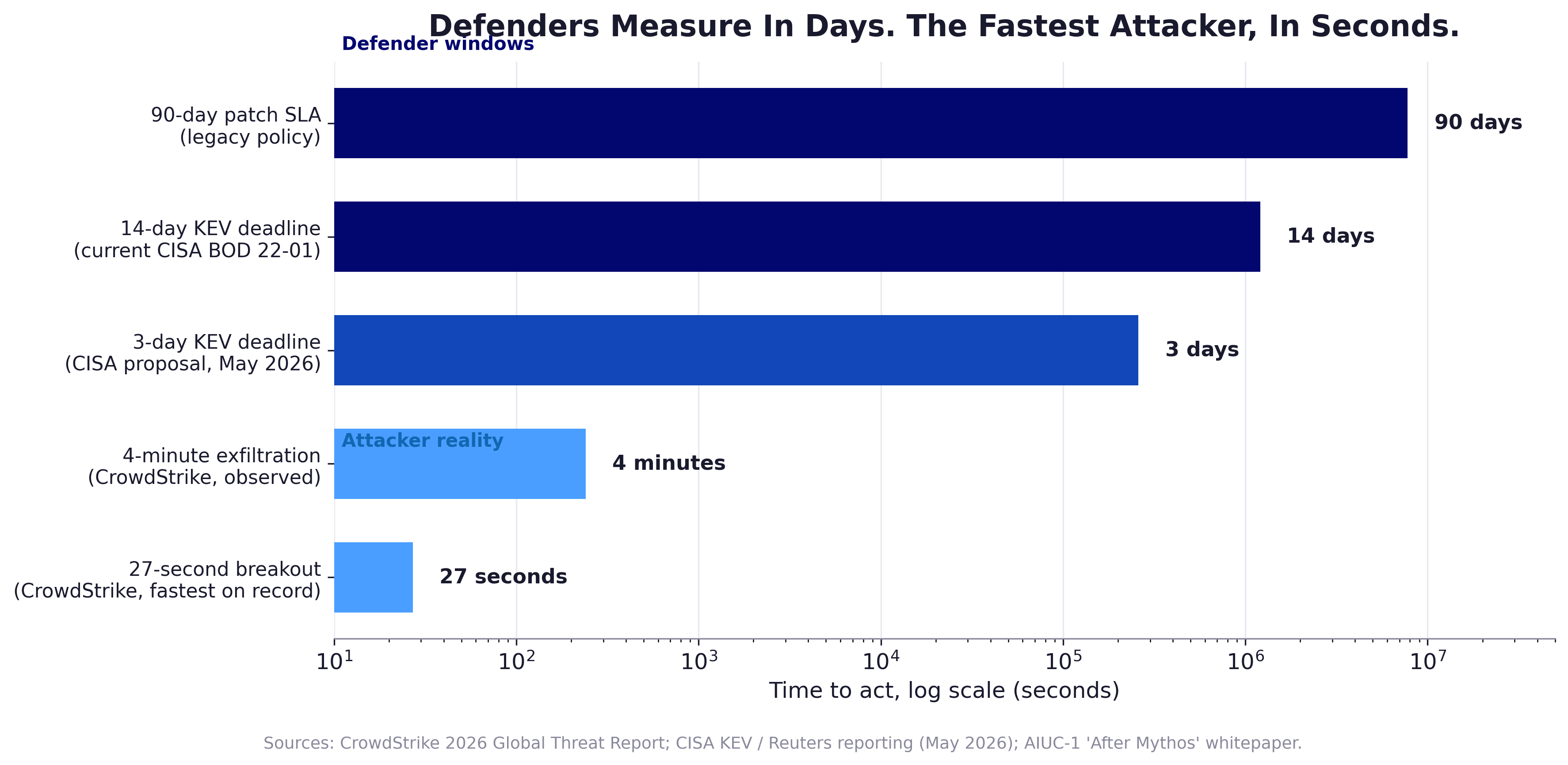
The trend line is the headline. The UK AI Security Institute estimates frontier cyber capability is doubling every 4.7 months, down from eight months late in 2025. CrowdStrike’s 2026 Global Threat Report, which is vendor telemetry rather than an independent study, recorded an 89% year-over-year jump in AI-enabled adversary operations, a fastest breakout of 27 seconds, and one intrusion where data left the building four minutes after initial access. Proliferation reaches the sectors that used to coast on obscurity and low adversary interest. Patch cadence, detection latency, and blast-radius tolerance were all calibrated for a world where elite offensive talent was scarce. That world is closing in months.
Imperative One: Ship The Patch, Start The Clock
The first imperative is the one your operations team will fight you on. Treat the moment you ship a fix as the disclosure event. A Mythos-class model takes the patched binary, diffs it against the prior release, finds the changed call paths, infers what the fix was protecting, and writes a working exploit, all without source code. Your exposure window opens when the patch ships, not when the CVE posts.
That breaks the 90-day SLA written into most security policies. It strains the 14-day window too. In May 2026, Reuters reported that CISA is weighing a cut of its Known Exploited Vulnerabilities remediation deadline to three days, with the acting director and the national cyber director in the discussion, driven explicitly by Mythos and GPT-class tooling. When the regulator starts talking about three days, your 90-day standard becomes a liability with a compliance stamp on it.
The practitioner moves to compress the patch cycle are concrete. Set patch SLAs in hours to days for internet-facing, actively exploited, and business-critical assets, and report them to the business as exposure windows rather than audit metrics. Run an LLM-driven security review on every modified line before release. Push the same discipline into procurement, so vendors who can’t demonstrate short SLAs and AI-assisted discovery get phased out. The supply chain is where this gets real. In March 2026, attackers hijacked the axios npm library, which sees more than 100 million weekly downloads, and the poisoned release executed inside OpenAI’s macOS app-signing pipeline before the company rotated its certificate. OpenAI’s own exposure traced to a floating version tag and no minimum release age, the kind of hygiene gap a Mythos-grade adversary now finds at scale.
I’ve watched this exact argument for decades. Early in the 2000s, I sat with… and sometimes I was even a member of… security teams that fought compressing the patch SLA from 90 days to 30 because the business “couldn’t absorb the disruption.” Six months later, an unpatched system was the way in. The conversation hasn’t changed. The numbers have. Today, it’s hours-to-days against an operations team that wants weeks, and the adversary diffing your binary doesn’t care which side wins the meeting.
Imperatives Two And Three: Contain, Then Keep Pace
The second imperative is zero trust with the marketing stripped off. Design for breach means building containment in from the start, so a single foothold stays a single foothold. The reason this matters more now than a year ago shows up in CrowdStrike’s telemetry: 82% of intrusions in 2025 were malware-free, meaning attackers logged in with stolen credentials and used the tools already on the box. Signature defense is watching the wrong door.
Four moves carry most of the load. Put every agent on least agency, because agents are the fastest-growing population of credentialed actors in most enterprises, and they should default to managed non-human identities with scoped entitlements, clear ownership, and lifecycle controls. Lock endpoints with binary allowlisting, the highest-leverage control almost nobody outside regulated industries runs, because an allowlist doesn’t negotiate with an exploit. Treat microsegmentation as the multi-year program it is, and in the meantime, push controls outside the context window into gateways, identity, and execution environments where architecture enforces them. Stand up autonomous red teaming so containment gets verified under machine-speed pressure instead of being assumed in a slide. Pair all of it with recovery design: immutable systems, air-gapped backups, identity systems you can rebuild without trusting compromised credentials, and manual fallbacks for business functions that can’t withstand an extended outage.
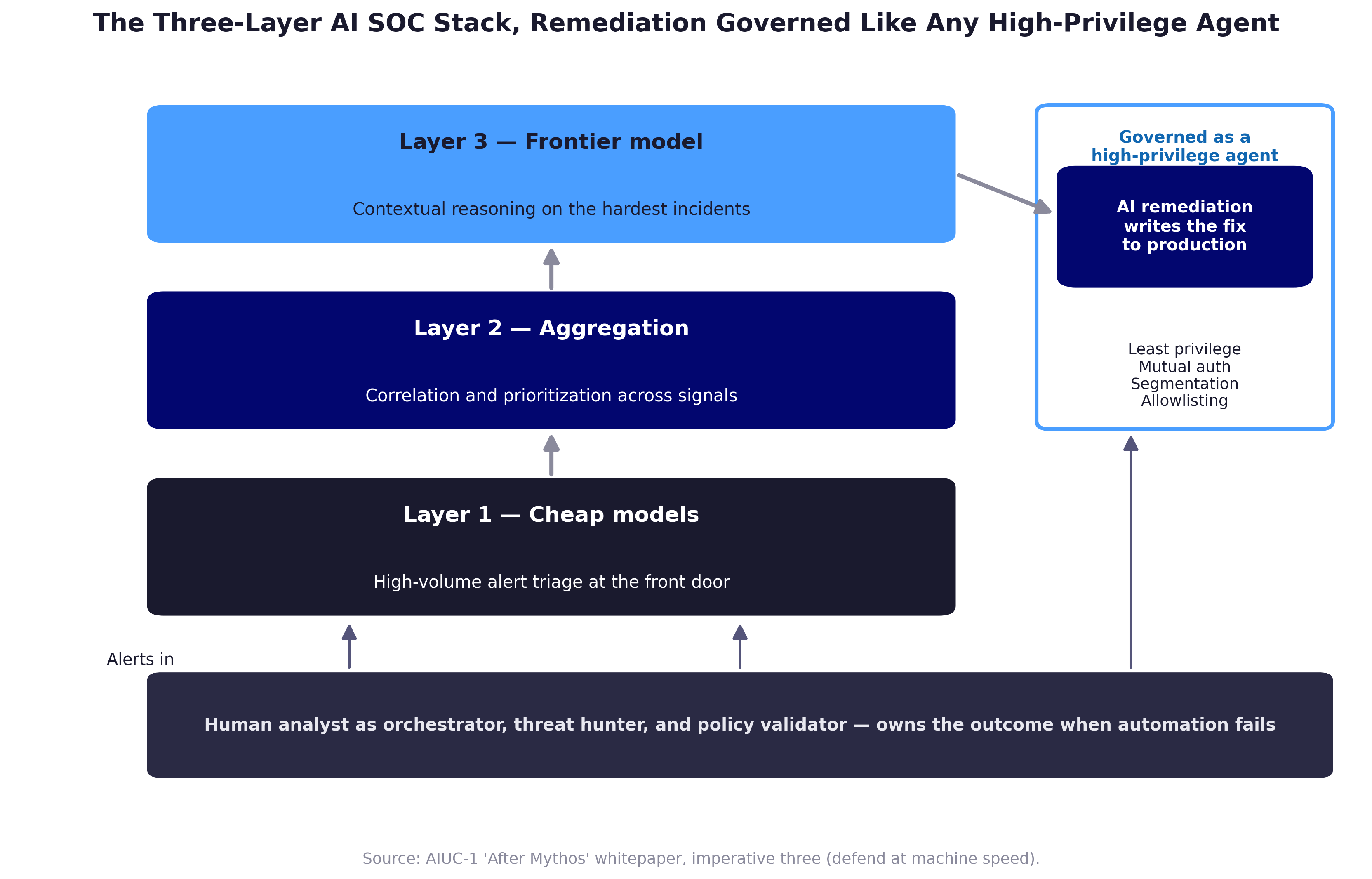
The third imperative is speed at the response end. Self-detection rate becomes your leading metric because handoff times are measured in seconds, and the failure you can’t afford is learning about a breach from an outsider. Build the machine-speed SOC in three layers: cheap models for high-volume triage, an aggregation layer for correlation and prioritization, and a frontier model on top for the contextual calls. AI remediation that writes the fix to production is the next step, and that agent holds write access to production with a target on its back, so it gets governed like any high-privilege agent, with least privilege, mutual authentication, segmentation, and allowlisting.
Here’s where I’d push past the document. The paper treats agents as high-privilege actors that need identity governance, which is correct and overdue. I’d go one layer down. The unit of governance is the runtime authorization scope of every agent, every session, every tool call. Static IAM is the precondition. Dynamic authorization scope, enforced at runtime, is the actual control.
Governance Is An Authority Problem
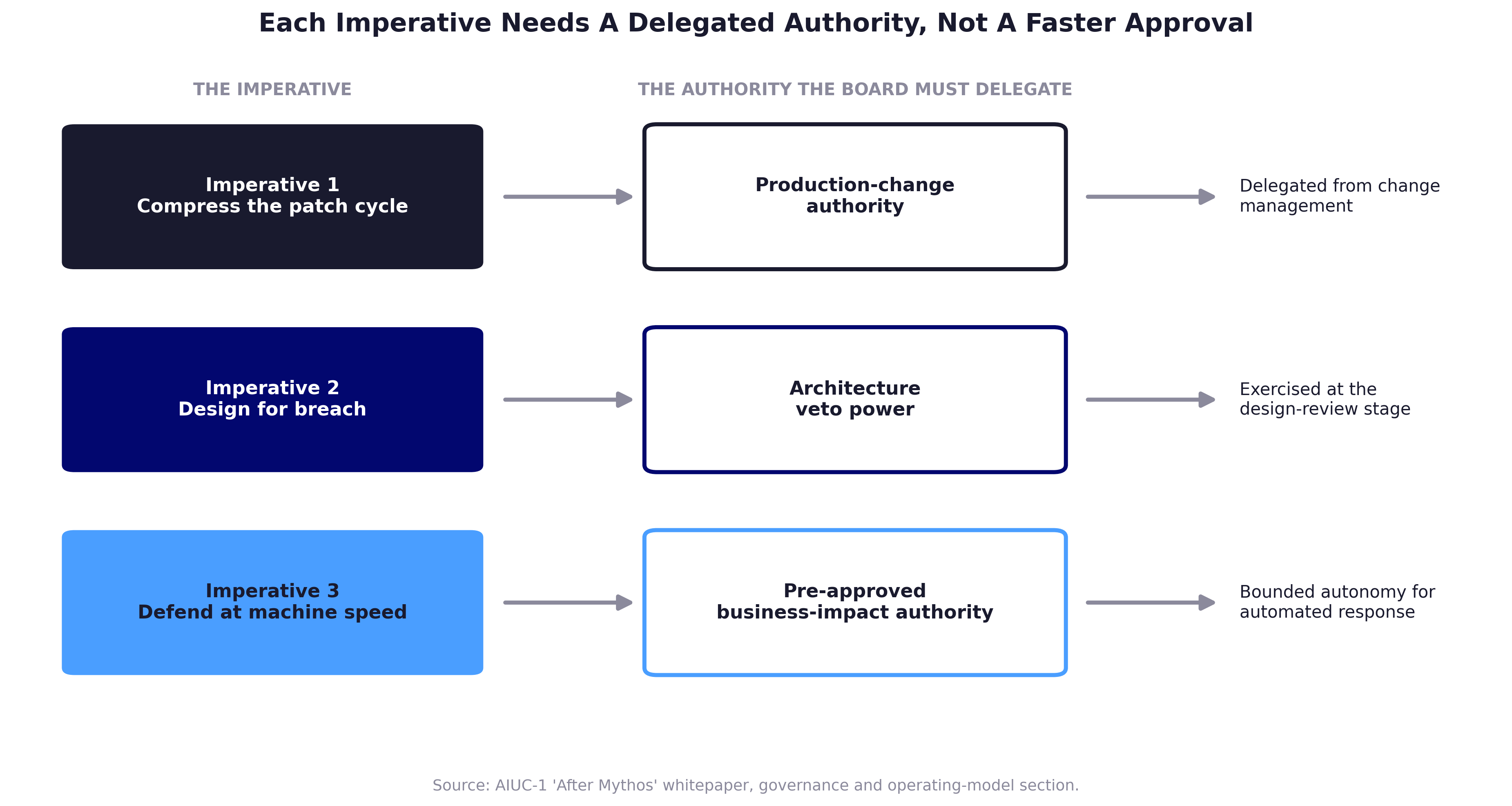
Skip past the three imperatives for a second, because every CISO already knows them. The document’s real contribution is its honesty about what blocks execution. A SOC re-tooled to run in minutes is still stuck if every new capability waits on control mapping, vendor risk, a procurement cycle, and a board cycle. Governance is where the gap closes first, and the whitepaper says so without flinching: machine-speed operation needs explicit authority boundaries, not faster approvals.
That resolves into three asks you can take to the board. Compressed patch SLAs need production-change authority delegated from change management. Design-for-breach needs architecture veto power exercised at the design-review stage, before the system ships rather than after. Machine-speed remediation needs pre-approved business-impact authority with bounded autonomy, so the response fires inside agreed limits without a 2 a.m. approval chain. A board that delays these authorities is choosing the readiness gap on purpose, whatever the slide says.
The whitepaper gets the credential point exactly right. Agents are a population that needs IAM treatment by default, not a special case bolted on later. My one extension connects to a position I’ve held for a while. Treat governance as architecture, not documentation. The authority structure the paper describes is the architectural-governance pattern in plain clothes. Self-detection rate is the right metric for detection, and the thing that produces a good one is an architectural commitment, not a policy PDF that says you value visibility. Write the control into the system, or you don’t have it.
Key Takeaway: The whitepaper’s 4 out of 10 is a confession in print, and the move that closes the machine-speed defense gap is delegating three authorities your board can grant this quarter.
What To Do Next
Read the whitepaper yourself at aiuc-1.com. Then run four moves before the quarter closes. Send the paper to your direct reports with one ask: map current SLAs against the three imperatives and flag every gap. Schedule a board cycle on the three authority delegations. Run a preparedness self-rating with your security leadership and compare your number to the 4 out of 10 baseline. Map your top five production agents against the least-agency, allowlist, segmentation, and autonomous-red-team checklist from the second imperative.
If you want the operating-model view behind this, governance-as-architecture and least agency are the two positions I keep coming back to, and I write about across the newsletter archive at rockcybermusings.com. The board and security-leadership advisory work lives at rockcyber.com if you want to pressure-test your own number against the baseline.
👉 Subscribe for more AI security and governance insights with the occasional rant.
👉 For ongoing analysis of agentic AI governance frameworks, the conversation continues at RockCyber Musings.
👉 Visit RockCyber.com to learn more about how we can help with your traditional Cybersecurity and AI Security and Governance journey.
👉 Want to save a quick $100K? Check out our AI Governance Tools at AIGovernanceToolkit.com
👉 As a bonus, check out my conversation with Eva Benn where we talked about the cybersecurity skills you need to develop to stay relevant in 2026 and beyond.
The views and opinions expressed in RockCyber Musings are my own and do not represent the positions of my employer or any organization I’m affiliated with.